


Knowledge Base
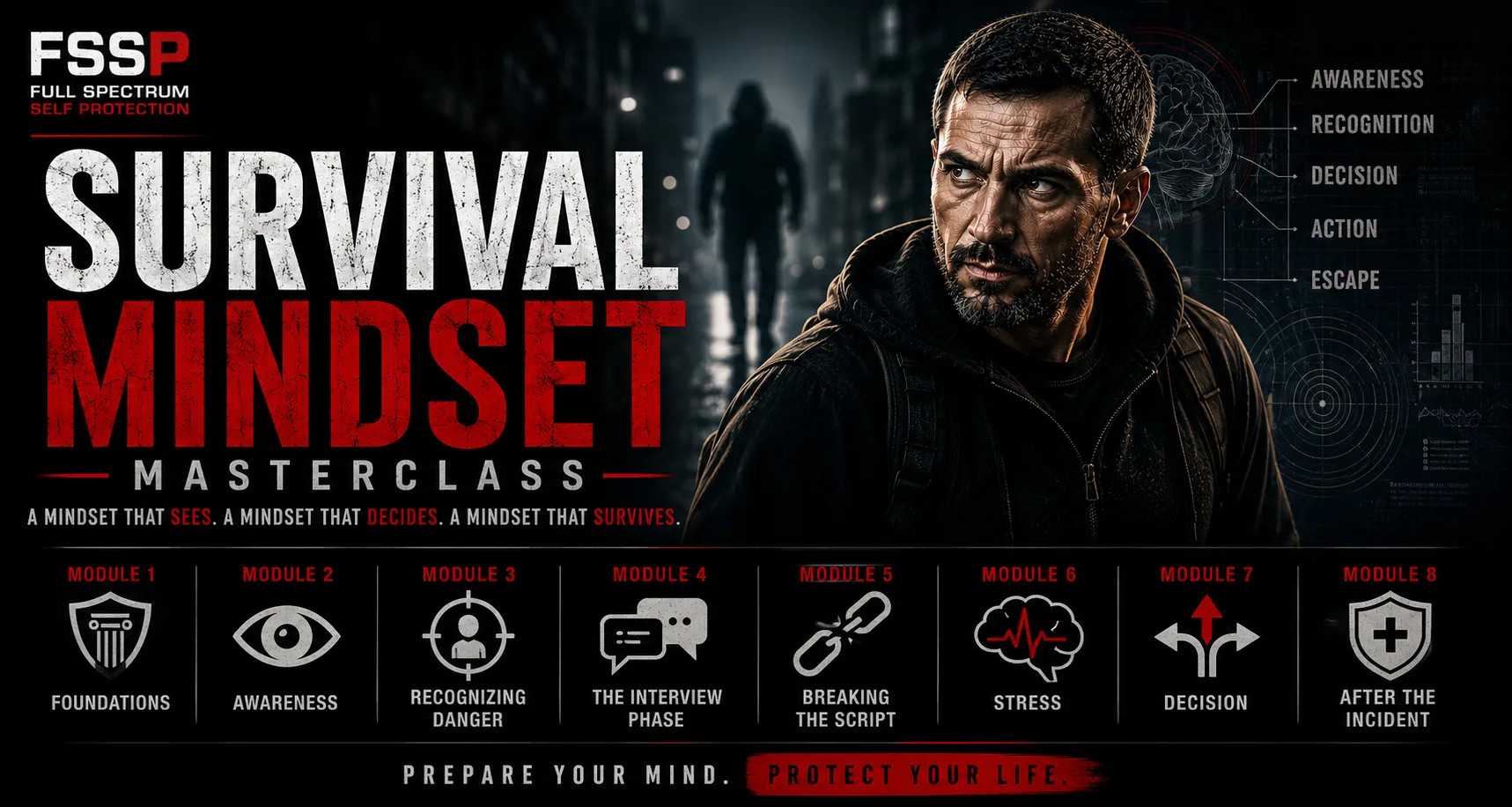
Survival Mindset: How to Think Clearly Under Stress
FOUNDATIONAL COMBAT PSYCHOLOGY
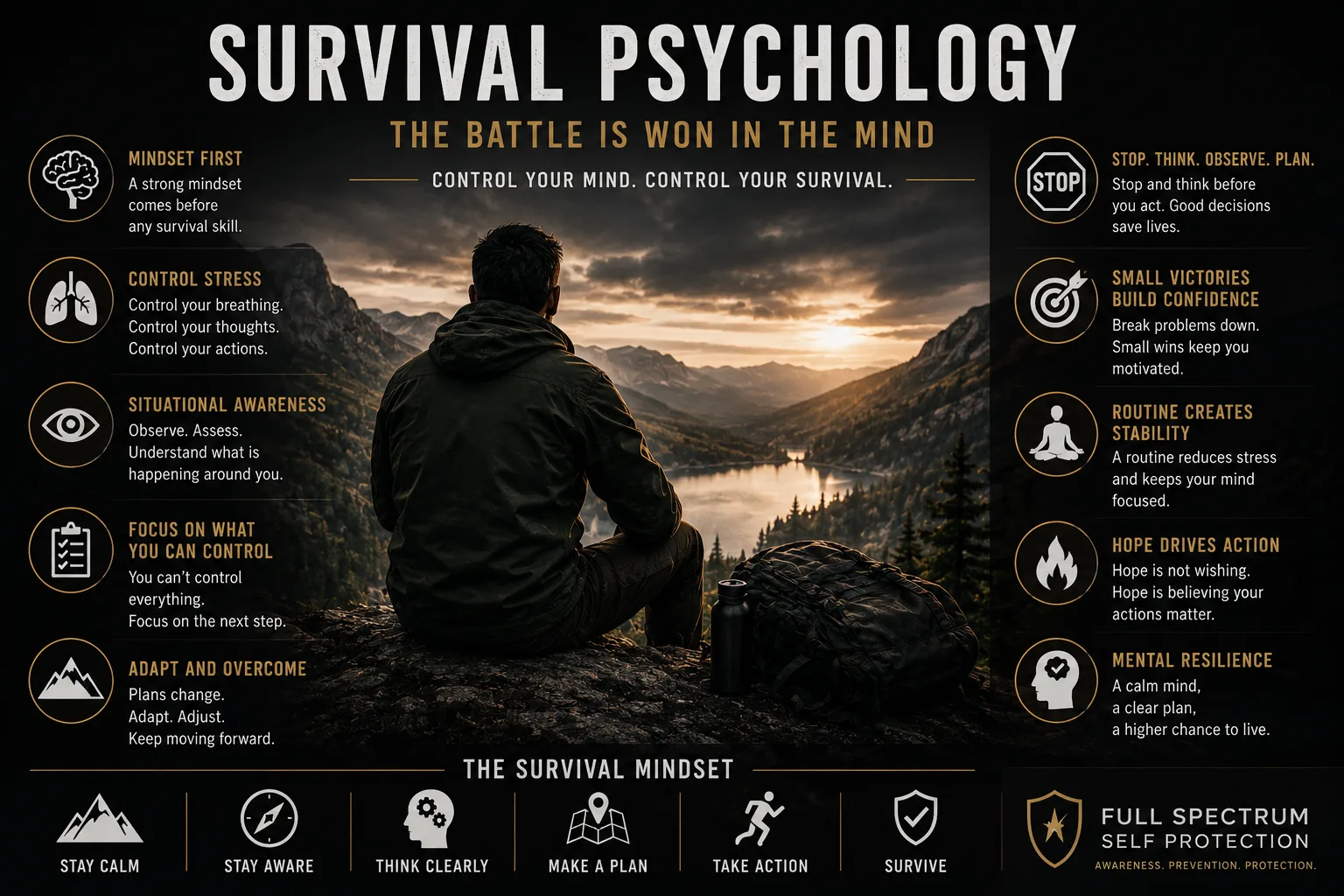
If there is one area of self-protection that is consistently underestimated, it is mindset. Most people assume that surviving a violent encounter is primarily about physical ability. They believe the person with the best techniques, the fastest punches, or the most experience in a gym will automatically prevail.
Reality tells a different story.
The most important factor in any violent encounter is not your equipment. It is not your techniques. It is not even your physical fitness. It is your mindset. This is why mindset forms the foundation of the Survival Pyramid.
The Survival Pyramid
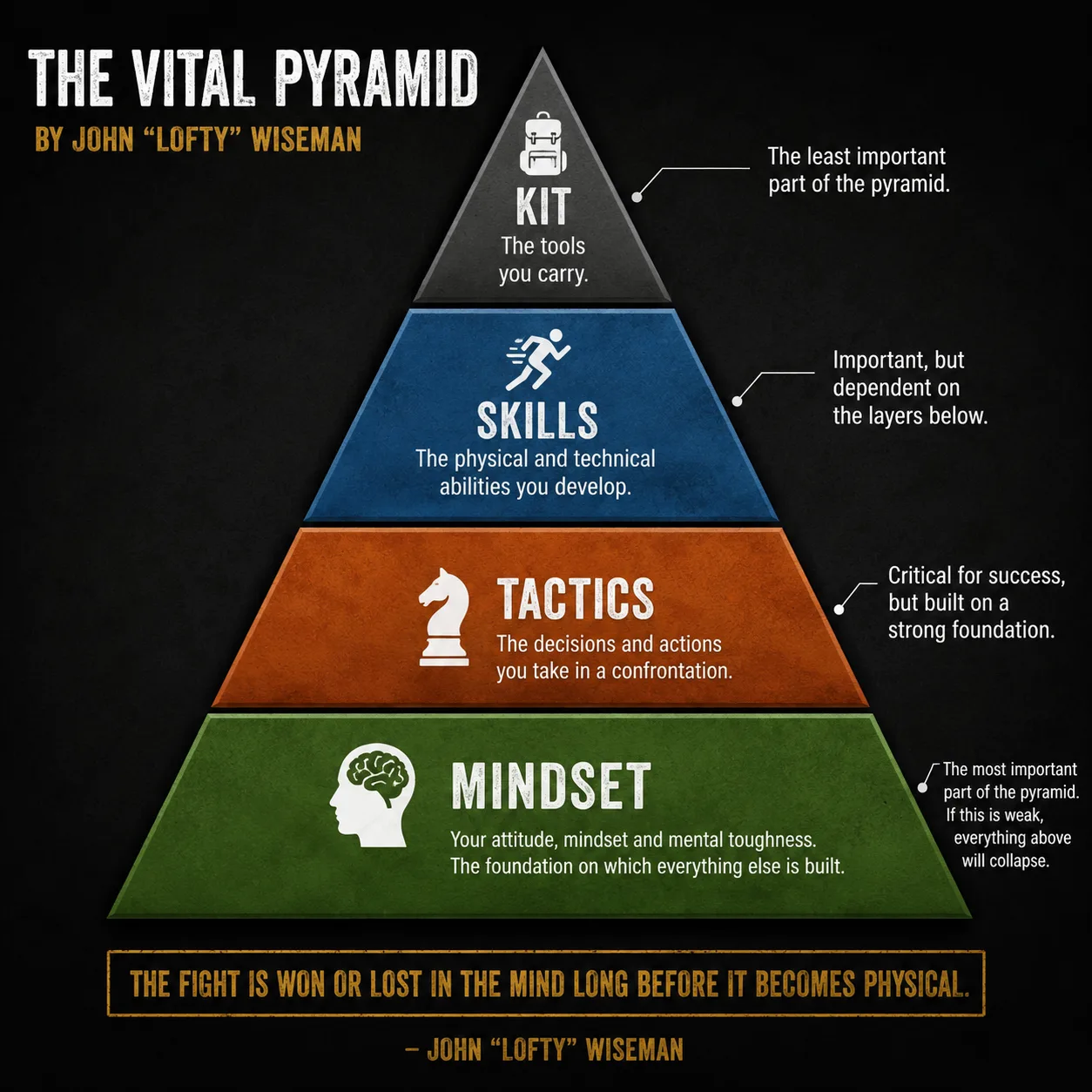
At Full Spectrum Self Protection, we use a version of the Survival Pyramid often associated with John "Lofty" Wiseman. The pyramid consists of four levels:
- Mindset: Your attitude, mental toughness, and the foundation on which everything else is built.
- Tactics: The decisions and actions you take in a confrontation.
- Skills: The physical and technical abilities you develop through training.
- Kit: The tools and equipment you carry.
The size of each level reflects its importance. Mindset forms the largest part of the pyramid because everything else depends on it. Most people focus on the wrong parts—they spend hours discussing gear or obsessing over techniques. Yet you can own the best equipment in the world; if your mindset fails when violence appears, none of it will be used. The fight is often won or lost in the mind long before it becomes physical.
Where Mindset Comes From
One of the biggest misconceptions is the belief that mindset is something people either have or do not have. In reality, mindset is largely shaped by two factors: **your upbringing** and **your life experiences**.
A person who grew up in a stable environment often expects people to behave reasonably and politely. Unfortunately, predators often exploit exactly these qualities. When confronted by genuine aggression, well-adjusted people struggle to accept what is happening, searching for alternative explanations while the aggressor is already acting.
By contrast, people who have experienced violence or chaotic environments do not deny its existence. They recognize danger more quickly and react more decisively. The challenge for self-protection instructors is helping students understand those realities without forcing them to experience genuine violence themselves.
Accepting Reality & Studying Violence
The first step in developing the survival mindset is accepting reality: **Violence exists everywhere.** Preparation is not paranoia; it is responsibility. You wear a seatbelt even though you do not expect an accident.
One of the most effective ways to develop a realistic mindset is to study real-world incidents rather than movies. Analyze surveillance footage, read case studies, and look for patterns. The goal is not fear—it is familiarity. The more familiar violence becomes, the less likely you are to freeze.
Closing the Gap Between the Dojo and Reality
Traditional training environments are highly predictable. Real violence provides none of these comforts. Realistic training must expose students to uncertainty, pressure, confusion, and stress. Scenario training is critical because it teaches students to function despite uncertainty—making the unknown feel less unknown.
Verbal Pressure Training
Many people freeze before a single punch is thrown, not because they are physically incapable, but because they are psychologically overwhelmed by shouting, threats, and an invasion of personal space. Realistic training must include verbal pressure. The first time somebody experiences aggressive verbal confrontation should not be on the worst day of their life.
State Access and State Management
This means recognizing your emotional state and being able to deliberately influence it through behavior. The principle is simple: Act first. Feel second.
At FSSP, students learn how to deliberately project confidence, determination, and controlled aggression. Stand taller. Move with purpose. Use a stronger voice. Take up space. Over time, the mind begins to follow the body. A strong verbal response does more than communicate with the aggressor—it shifts your own psychological state from passive observer to active participant.
The Decision Must Be Made Beforehand
Perhaps the most important lesson of all is this: **The decision to act must be made before the event occurs.** Under extreme stress, people do not rise to the occasion—they fall back on their preparation. Mindset development is ultimately about removing hesitation. In a violent encounter, the person who recognizes reality first and acts decisively gains a tremendous advantage.
THE GOAL: CAPABILITY OVER FEAR
The goal of mindset training is not to create violent or fearless people. Fear is normal and healthy. The goal is to create capable people who can manage fear, think under pressure, and act despite uncertainty. Because when everything else is stripped away—when plans fail and equipment is unavailable—only one thing remains: Your mindset. And that is where survival begins.
THE FIGHT IS WON OR LOST IN THE MIND LONG BEFORE IT BECOMES PHYSICAL.
Awareness: The Foundation of Full Spectrum Self Protection
MINDSET & SITUATIONAL AWARENESS
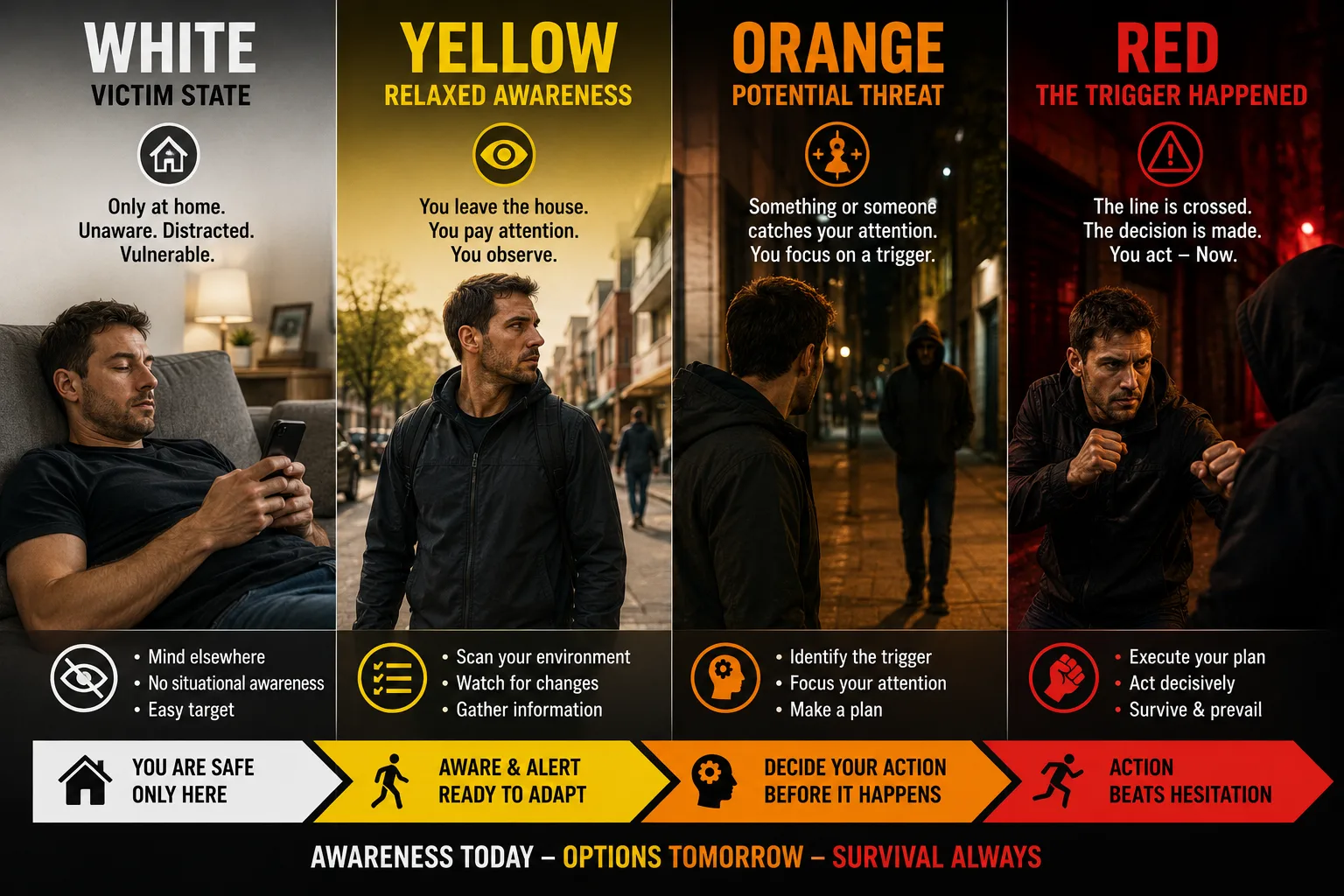
When people think about self-protection, they often imagine physical techniques, defensive tools, or fighting skills. While these things have their place, the reality is that the vast majority of dangerous situations are won or lost long before physical contact occurs.
The single most important skill in personal protection is awareness.
Awareness allows us to identify potential threats early, make better decisions, avoid danger whenever possible, and gain valuable time if a confrontation becomes unavoidable.
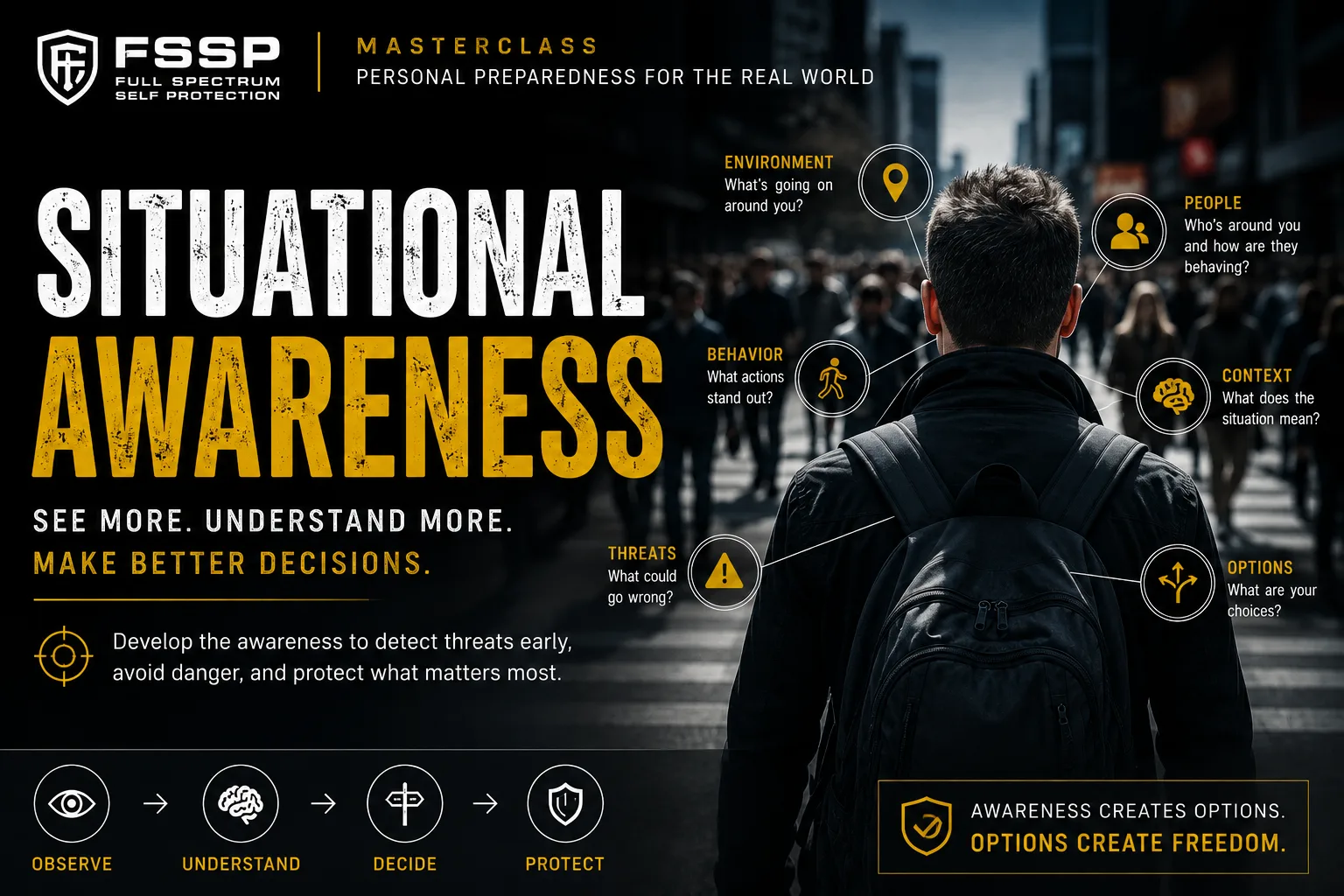
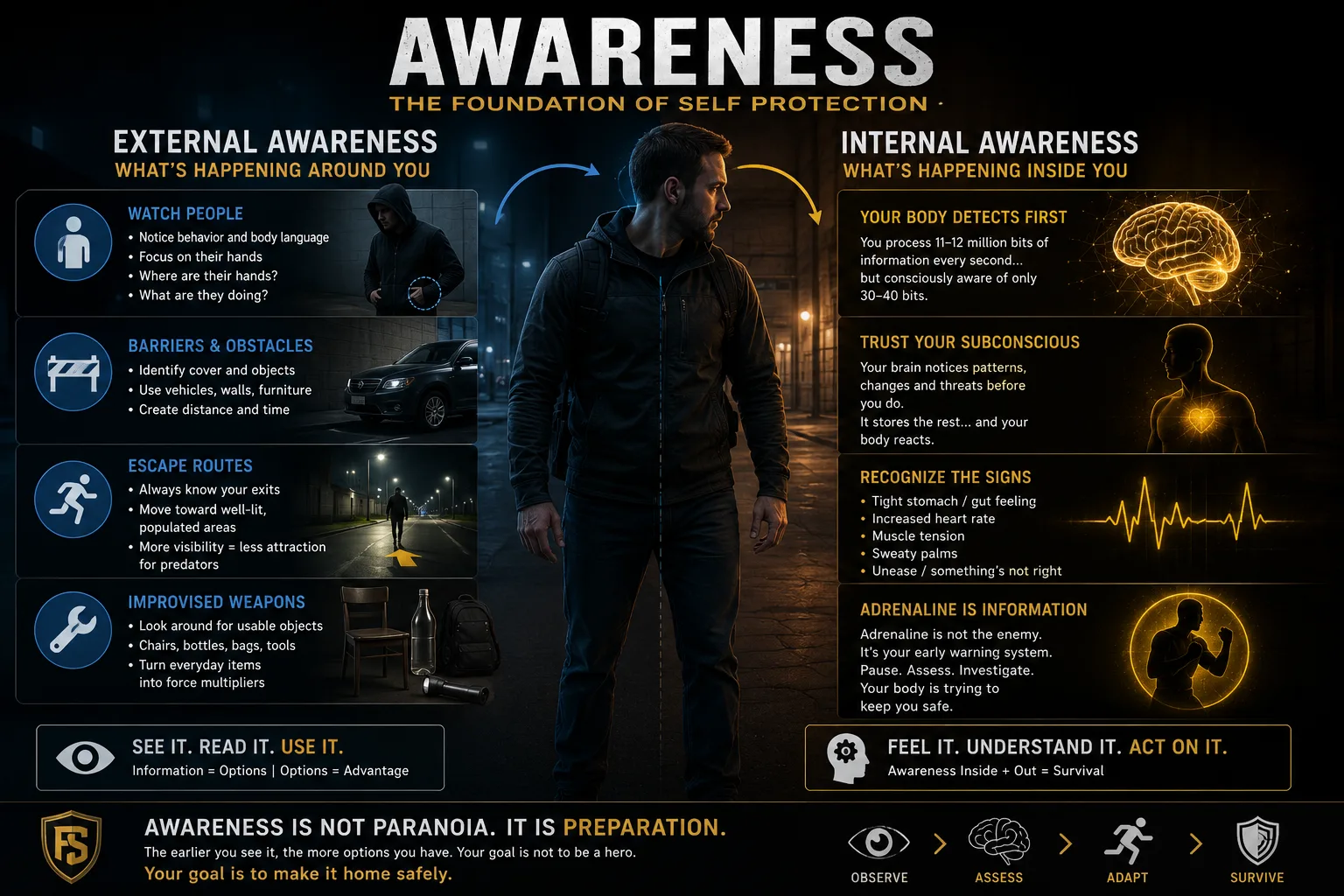
At Full Spectrum Self Protection, we divide awareness into two distinct categories: External Awareness and Internal Awareness. Understanding both is essential because survival is not only about recognizing what is happening around you—it is also about recognizing what is happening inside you.
External Awareness: Understanding Your Environment
External Awareness is everything that exists outside of yourself. It is the continuous process of observing your surroundings, identifying potential threats, recognizing opportunities, and understanding the environment in which you are operating.
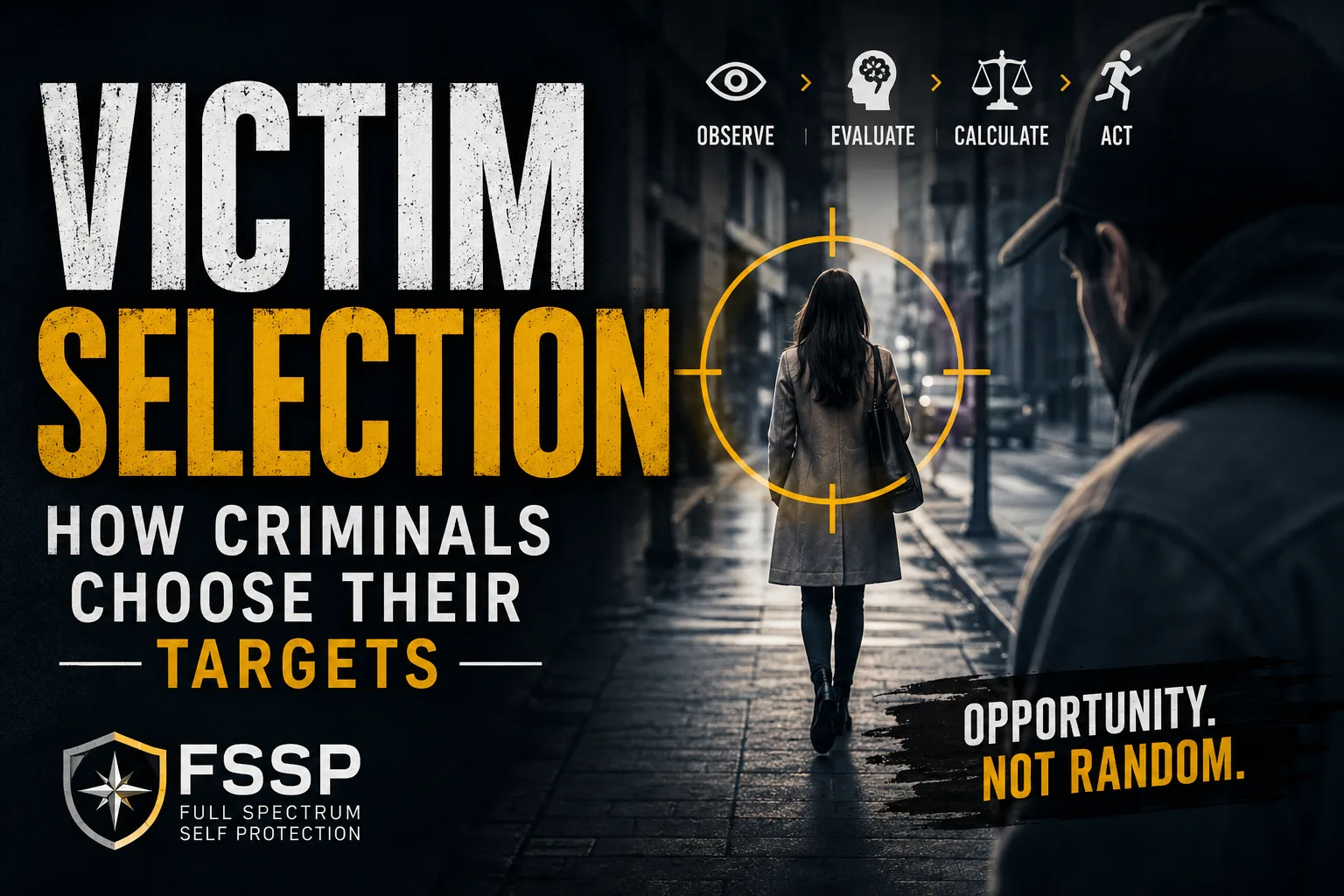
Most people move through life in a highly distracted state. They walk while looking at their phones, wear headphones, or become absorbed in conversations. Predators thrive on distraction. The more aware you are, the harder you become to target.
1. Watching People (Hands Tell the Truth)
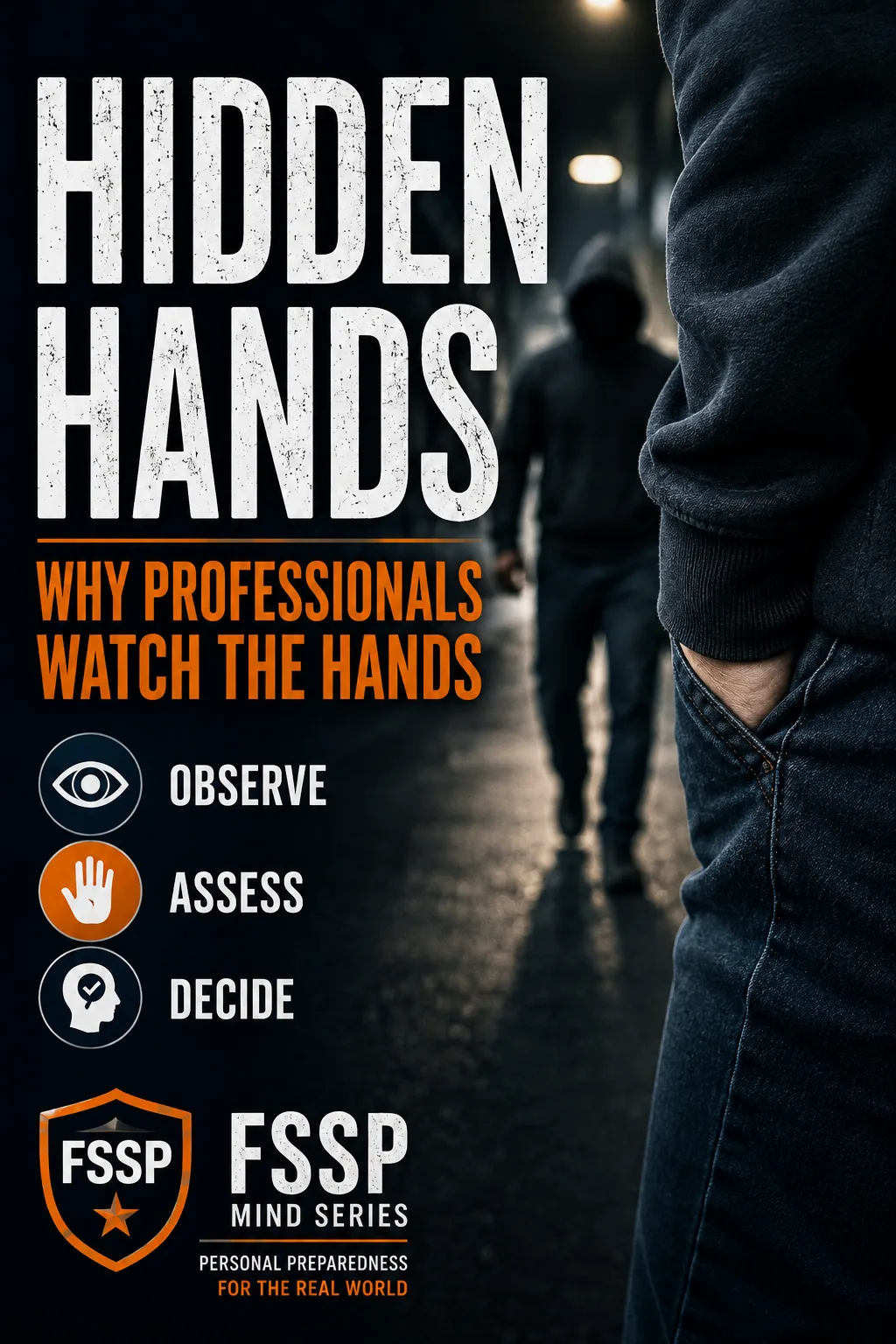
Every threat begins as a person. When someone catches your attention because their behavior feels unusual, your focus should immediately shift to one critical area: Their hands.
Hands are what grab, strike, conceal, and produce weapons. While the face rarely tells you what matters most, the hands reveal intent long before words do. Ask yourself: Can I see both hands? Are they hiding one hand? Are they reaching into a pocket or waistband?
2. Identifying Barriers and Obstacles
Every environment contains physical structures that can increase your safety. A parked vehicle can become a barrier, a table can become a shield, and a doorway can become a bottleneck. Anything that slows an aggressor down gives you more time to think, react, escape, or seek help.
3. Recognizing Escape Routes
Identify escape routes before you need them. When panic sets in, decision-making slows down. Scan for doors, stairwells, and open pathways. Move toward well-lit, populated areas. Predators dislike attention and privacy loss makes you a highly unattractive target.
4. Improvised Weapons
The world is full of objects that can enhance your defense: chairs, bottles, flashlights, backpacks, or fire extinguishers. The person who recognizes available resources has more options. The goal is not to become aggressive, but adaptable.
Internal Awareness: Understanding Yourself
While External Awareness focuses on the environment, Internal Awareness focuses on you—the ability to recognize your own physical and emotional responses. In many cases, your body notices danger before your conscious mind does.
1. Trusting the Early Warning System
The human nervous system processes approximately 11 million bits of information every second, yet we consciously perceive only around 30 to 40 bits. Your subconscious mind is constantly analyzing body language, movement patterns, and social dynamics. Your body often reacts before your conscious mind understands why.
2. The Feeling in Your Gut & Adrenaline
That sudden "gut feeling" or tightening stomach is your subconscious mind detecting subtle indicators of potential danger. Adrenaline is not your enemy; it is an early warning survival tool that prepares the body for action through increased heart rate, muscle tension, and sweaty palms. Instead of ignoring these signals, learn to investigate them: 'What has my body noticed?'
The Connection: The Feedback Loop
The most effective self-protectors combine both forms: External Awareness gathers information; Internal Awareness interprets your body's response to it. Together, they create a powerful loop:
OBSERVE → ASSESS → ADAPT → SURVIVE
AWARENESS IS NOT PARANOIA. IT IS PREPARATION.
The purpose of awareness is not to live in fear. The purpose is to recognize problems early enough that you still have options. Your goal is not to be a hero. Your goal is to make it home safely.
SEE IT. READ IT. USE IT. | FEEL IT. UNDERSTAND IT. ACT ON IT.
What Is Situational Awareness? The Foundation of Personal Preparedness
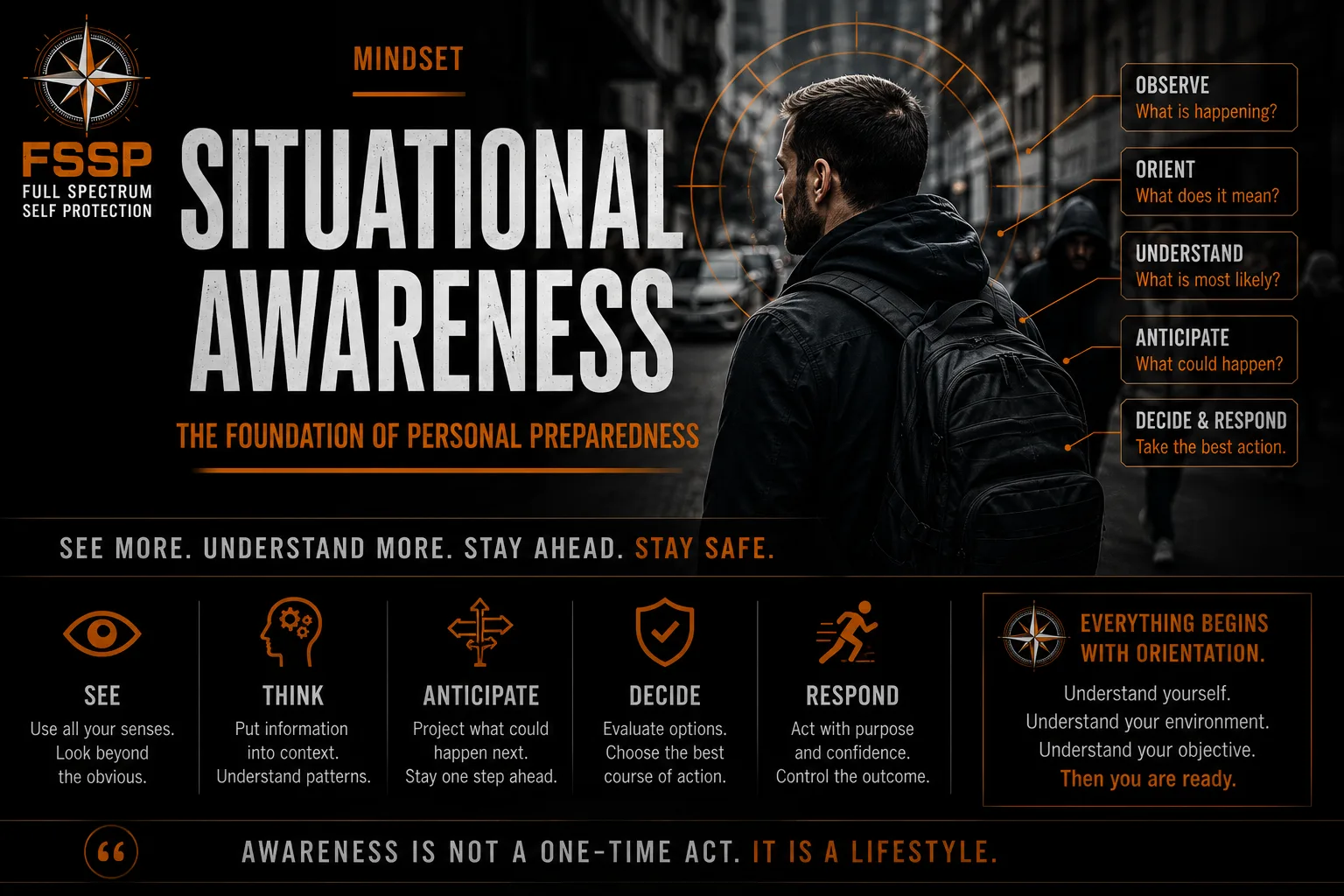
Most people think situational awareness means simply looking around. They believe awareness is about spotting suspicious people, watching hands, identifying exits, or scanning the environment. All of those things are important. But they only tell part of the story.
At FSSP, we teach something we call Awareness 2.0. It goes beyond simply observing what people are doing. It focuses on how they are doing it—the small physiological and behavioural clues that reveal what is happening inside a person's mind. These subtle indicators rarely provide certainty on their own. But when combined with everything else you've already observed, they can help you make better decisions earlier.
Context Is Everything
Before we look at specific indicators, it's important to understand one fundamental principle: No single indicator proves anything. One person may be nervous because they're about to commit a violent crime. Another may be nervous because they're late for work. Someone may be sweating because they're carrying a weapon, or simply because it's 35 degrees outside. Awareness is never about jumping to conclusions. It's about collecting information. Every observation adds another piece to the puzzle.
Facial Colour
One of the easiest things to observe is a person's facial colour. Our emotions directly influence our circulatory system. When people experience different emotional states, blood flow changes, and those changes are often visible:
- Pale Skin: A person who suddenly becomes very pale is often experiencing fear. Fear causes the body to redirect blood toward vital organs in preparation for survival. This is important because fear doesn't always look passive. Some frightened people become aggressive. If you continue applying pressure to someone who is acting out of fear, you may unintentionally escalate the situation. Remember: Not every loud person is angry. Sometimes they're terrified.
- Red Face: A bright red face often indicates anger. As adrenaline increases, blood vessels dilate and blood flow to the face increases. Combined with other indicators, a flushed face may suggest that someone is emotionally escalating toward violence.
The Physiology of Voice
A person's voice often reveals more than their words. Pay close attention to these vocal signatures:
- High-Pitched, Fast Speech: People experiencing fear or high stress frequently speak faster. Their voice becomes higher, breathing shallow, and sentences rushed or repeated. These are common signs of anxiety and nervousness.
- Low, Tight Voice: Someone preparing for violence often sounds different. The voice becomes lower, speech slows down, and words are delivered through clenched teeth. The jaw tightens and facial muscles become rigid. Instead of sounding frightened, they sound controlled. This combination often indicates determination rather than panic.
Contextual Anomalies and Behavioural Clusters
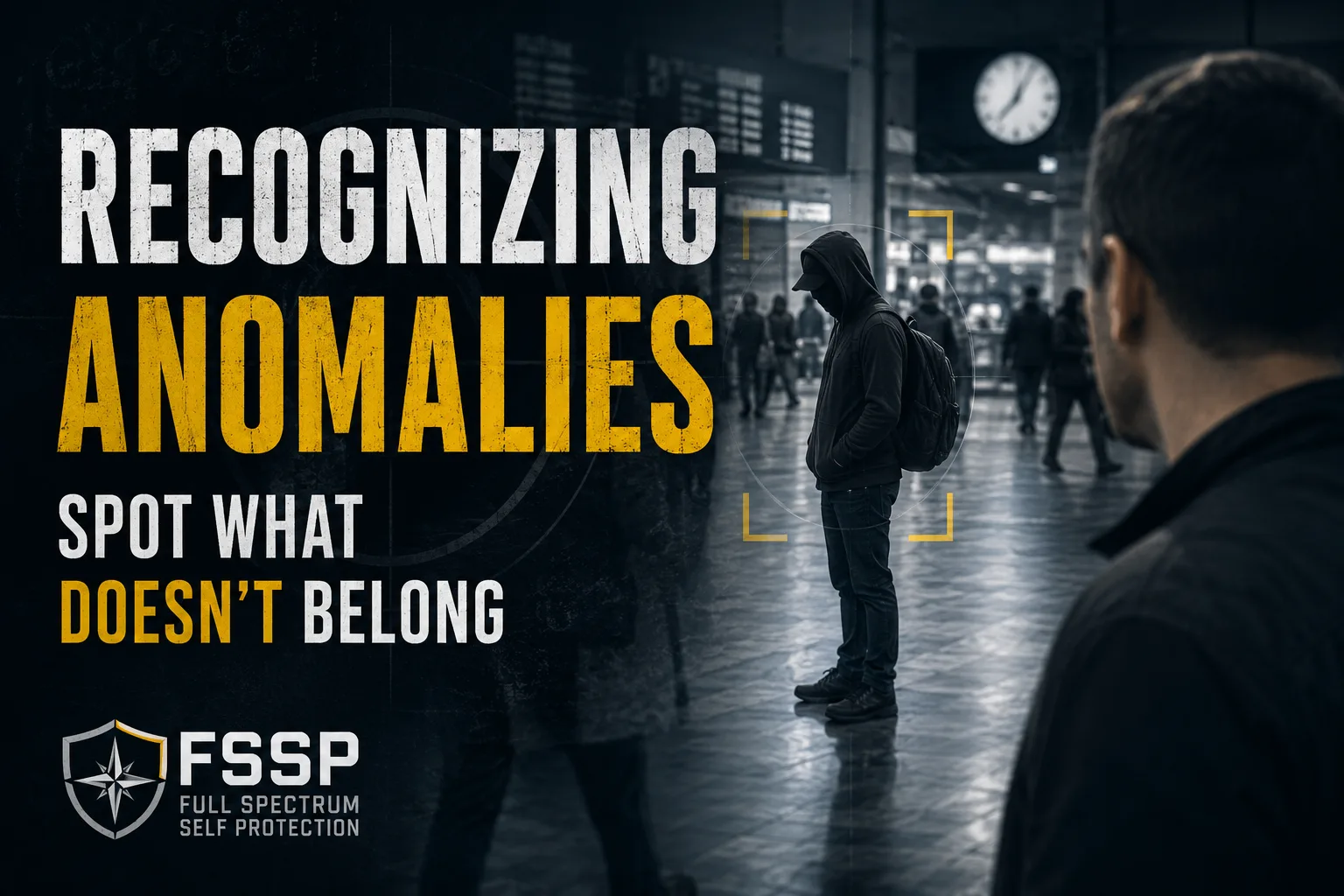
Clothing always needs to be interpreted within its environment. Most clothing choices are normal, but anomalies deserve attention—like someone wearing a heavy coat in 30°C heat while carrying a large bag and checking the time. One unusual behaviour means very little, but several occurring together form a behavioural cluster. Professional observation focuses on these groupings:
- Heavy clothing on a hot day.
- Constantly checking the time and repeatedly scanning the environment.
- Nervous body language and avoiding eye contact.
- Holding onto a bag or concealed area unusually tightly.
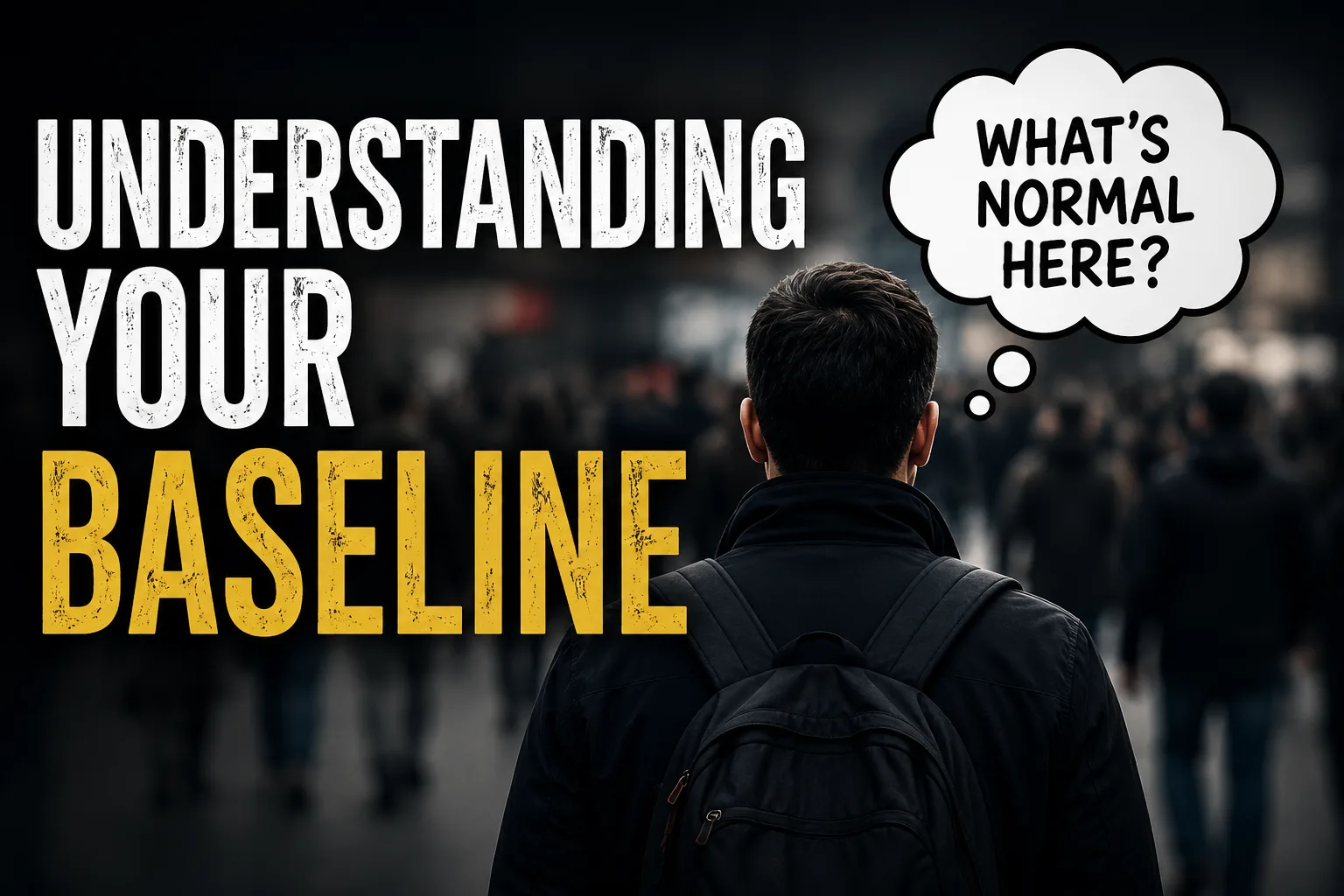
"Awareness is about observation, not judgement. We don't judge people. We observe behaviour, evaluate context, and continuously update our assessment as new information becomes available. Good awareness isn't about being suspicious of everyone; it's about recognising when something doesn't fit the normal baseline."
Awareness 2.0 isn't about developing supernatural instincts. It's about learning to notice details that most people overlook. The earlier you recognise that something is wrong, the more options you still have. And in self-protection, options are everything.
Recognizing Concealed Weapons – What Your Eyes Might Miss
One of the biggest mistakes people make is believing they'll always see a weapon before it's used. In reality... you often won't. Modern firearms and knives are designed to be carried discreetly. A concealed weapon is supposed to remain hidden. That's why situational awareness isn't about spotting the weapon itself. It's about recognising the small clues that suggest one might be there.
At FSSP, we don't teach people to assume everyone is armed. We teach them to recognise behaviours and indicators that deserve a second look.
Context Always Comes First
Before discussing specific indicators, remember one important principle: No single indicator proves that someone is carrying a weapon. A person touching their waistband might simply be adjusting their trousers. Someone wearing a jacket on a warm day might simply feel cold. Good awareness is never about making assumptions. It's about recognising patterns. The more indicators you observe together, the more attention the situation deserves.
Weapon Printing
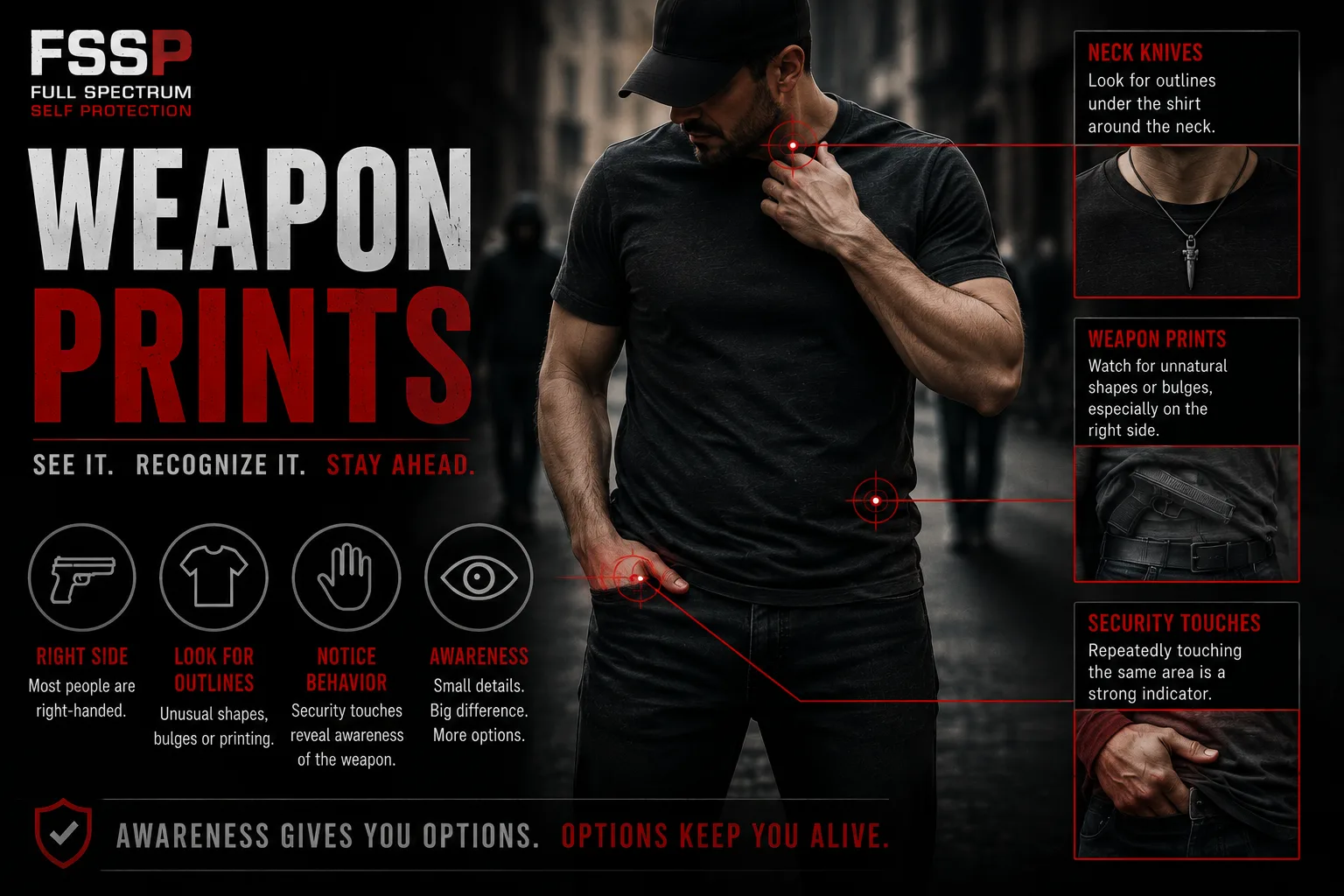
One of the most obvious indicators is something known as weapon printing. Printing occurs when the outline of a concealed weapon becomes visible through clothing. A pistol may create a square or angular shape around the waistband. A knife may create a long, straight outline inside a pocket. Sometimes the shape is obvious. Sometimes it's extremely subtle. Training your eyes to notice these irregularities can significantly improve your awareness.
Where Most Weapons Are Carried
Most people are right-handed. Because of that, many concealed weapons are carried on the right side of the body. Most commonly:
- Around the waistband.
- On the hip.
- Inside the waistband.
- In a front pocket.
This doesn't mean you should ignore the left side. It simply means that understanding common carry positions helps you know where to look first.
Neck Knives
Another less obvious method of carrying a weapon is the neck knife. These small knives hang from a cord around the neck and are concealed underneath a shirt. Although designed to remain hidden, they sometimes create a visible outline beneath thin clothing. Again... this doesn't automatically indicate criminal intent. Many outdoors enthusiasts legally carry tools this way. The important lesson is simply to recognise what you're seeing.
Security Touches
One of the strongest behavioural indicators isn't the weapon itself. It's the person carrying it. Individuals carrying concealed weapons often know exactly where that weapon is. Consciously or unconsciously, many repeatedly touch it. Security professionals sometimes refer to these as "security touches" or "security checks". Someone may repeatedly touch:
- Their waistband, pocket, or jacket.
- Their ankle, chest, or neck.
They're not necessarily preparing to attack. Often they're simply confirming that the weapon is still where they expect it to be. But repeated touching of the same concealed location deserves your attention.
Behaviour Matters More Than Equipment
At FSSP, we always place behaviour above appearance. Someone carrying a legally owned firearm responsibly may display none of these behaviours. On the other hand... someone preparing to commit violence often becomes highly aware of the weapon they're carrying. That's why behaviour is usually a better indicator than clothing alone.
Looking for Clusters
The real value comes from combining observations. Imagine someone:
- Repeatedly touches their waistband.
- Wears unusually heavy clothing despite hot weather.
- Constantly scans the environment and appears tense.
- Keeps one side of their body slightly turned away from others.
None of these observations alone prove anything. Together... they may justify increasing your awareness and creating more distance.
"Don't hunt for weapons. Your goal isn't to search every stranger for hidden weapons. That's impossible. Your goal is simply to recognise when something doesn't fit the normal baseline. If your awareness increases... create distance. Observe. Prepare. And if necessary... leave."
You don't need certainty to make a smart decision. You only need enough information to recognise that the situation deserves more attention. Because in self-protection, the earlier you identify potential danger... the more options you still have. Options are everything.