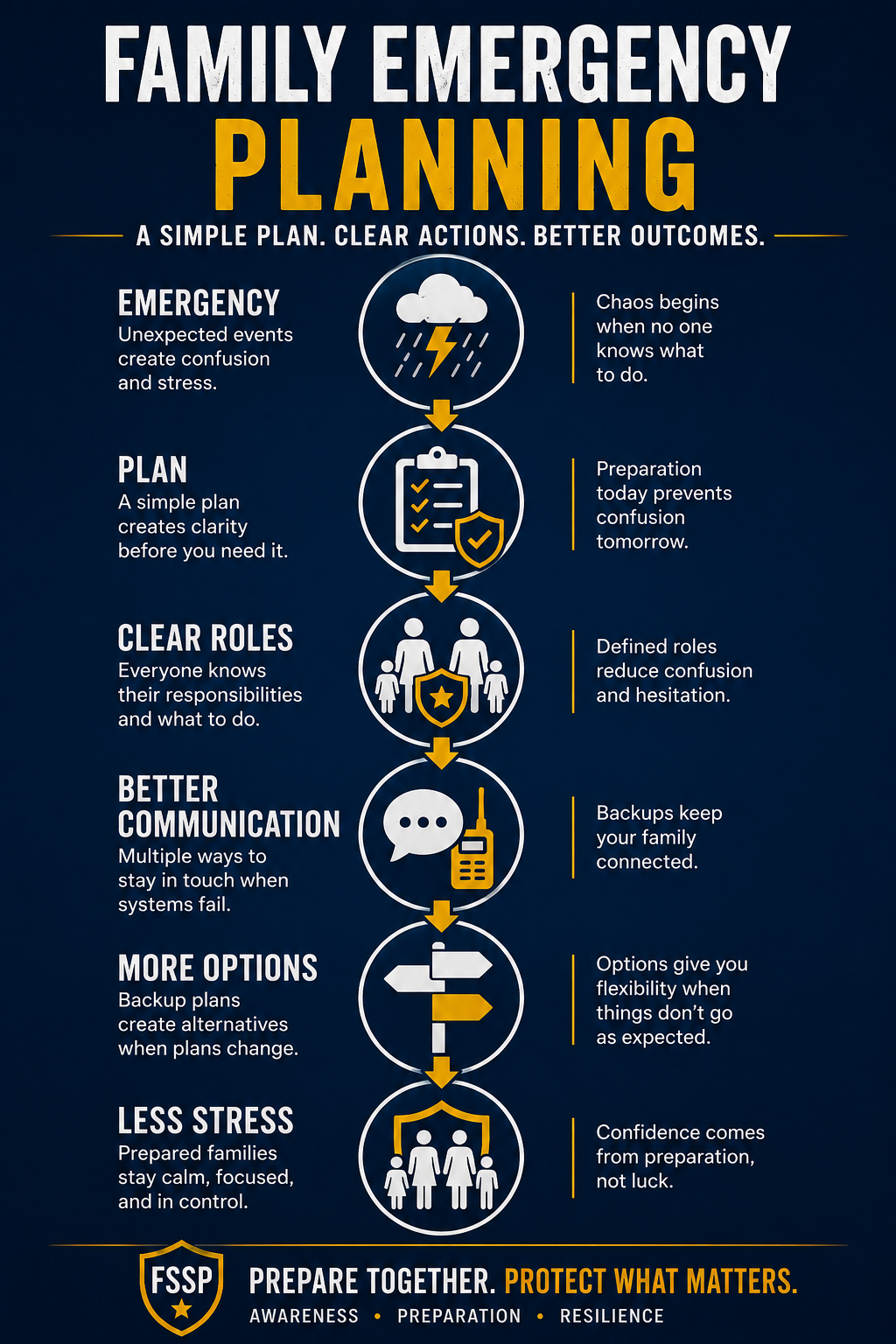
Why Every Family Needs a Plan
A simple family emergency preparedness plan doesn't eliminate emergencies—it reduces confusion when they happen. Emergencies don't always involve major disasters. A child missing the school bus, a sudden road closure, or a prolonged power outage can already test how well a family communicates and adapts.
Minor disruptions can quickly spiral into highly stressful coordination failures. A localized power outage, school closure, severe weather warning, or minor transit delay can create immediate logistical friction. Without a clear family emergency plan, basic tasks like pickup schedules, pet safety, or communication fall apart. Developing a robust approach to family emergency planning ensures that critical information is coordinated in advance. By building a thoughtful emergency family plan, you establish frameworks that avoid panic during unexpected events. Effective family preparedness and emergency preparedness are less about reacting to extreme, worst-case scenarios and more about establishing smooth, everyday coordination. A structured family safety plan or disaster family plan is the foundation of household resilience.
Planning Reduces Stress
When an emergency happens, cognitive load rises. Trying to decide who collects the kids, where to meet, or which route is safe while sirens are wailing creates instant decision fatigue. Pre-establishing roles and designating meeting points removes the pressure of thinking under stress. When a plan already exists, your family transitions from guesswork to active coordination. This preserves mental options and enables calm, structured execution.
Every Family Is Different
Preparedness plans must be customized for your household's unique needs rather than relying on rigid online checklists. An urban household relying on public transit will have very different meeting locations and evacuation protocols compared to a rural household with multiple vehicles. Similarly, homes with infants, elderly relatives, or pets require specific planning for medication, mobility, and supplies. Your plan should match your daily routines and environment.
Consider Individual Needs
Every family carries unique responsibilities. Effective plans explicitly account for family members who require tailored support:
- Young Children: Need simple, age-appropriate instructions and familiar meeting spots.
- Older Adults: May require assistance with mobility or access to essential prescription medications.
- Medical Conditions: Require specialized supplies, power dependency backups, or physical documentation.
- Pets & Animals: Need pre-packed food, carriers, leash arrangements, and shelter access options.
Your plan should account for anyone who may require additional assistance, special care, or alternative communication under high stress. Preparedness works best when everyone is included.
Every Plan Should Answer Five Questions
Building a successful safety framework starts by resolving five fundamental questions before an event occur:
- 1. How do we communicate? Establish primary and secondary communication methods. If cell towers are overloaded, voice calls often fail. Text messages, web-based messaging apps, or an out-of-area contact person serve as valuable fallbacks (analyzed in Everyday Redundancy).
- 2. Where do we meet? Designate two specific spots: a primary spot near your home (like a specific neighbor's porch) and a regional backup location (like a library or relative's home) if your neighborhood becomes inaccessible.
- 3. Who is responsible for what? Assign clear duties to prevent double-work or hesitation. Who secures the home? Who contacts the primary out-of-area coordinator? Who is responsible for grabbing the pet supplies or medical kits?
- 4. What if we cannot reach each other? Have a fallback protocol. If all communication fails, everyone should know the exact timeline to wait or head to the secondary meeting location.
- 5. What information should everyone know? Ensure every family member has access to critical numbers, physical home and office addresses, and basic medical history. Write this information down physically rather than relying entirely on digital devices (as noted in Digital Security).
Practice Matters
The best plan on paper is useless if nobody remembers it. Preparedness improves through practical repetition, not paper perfection. Run simple walkthroughs, discuss hypothetical scenarios at the dinner table, and practice finding alternative driving routes (refer to Vehicle Security). Review and update the plan at least once a year as phone numbers, school locations, or jobs change.
If a plan is too complicated to remember during acute stress, it is too complicated to execute. Simplicity increases operational reliability.
Common Mistakes to Avoid
Ensure your plan does not fall victim to these common pitfalls:
- Keeping the plan secret: Writing down details but never sharing or discussing them with children or co-parents.
- Assuming uncommunicated knowledge: Assuming a partner knows where to meet or who is responsible for pickups without explicit alignment.
- Relying on a single mobile network: Assuming cellular voice calls will work during regional power outages or high-demand emergencies.
- Neglecting updates: Leaving old phone numbers, inactive workplaces, or outdated school protocols in your documentation.
- Overcomplicating procedures: Designing multi-page plans that are impossible to execute under stress. Simple is always more reliable.
Practical Scenario: The Severe Storm & Network Outage
Practical Scenario: Managing Widespread Disruption
A severe storm damages regional infrastructure during a workday afternoon, causing sudden power outages and jamming cell towers while parents are at work and children are at school.
Without a Plan: High anxiety, frantic driving, conflicting assumptions, and guesswork under pressure.
With a Simple Plan: Parents know exact pickup assignments, children know which pre-authorized neighbor to wait with if needed, and everyone understands the secondary meeting location.
The Result:
The external storm remains identical, but the family's internal coordination prevents panic and ensures safe reunion.
Key Takeaways
Key Takeaways
- A simple family emergency plan transforms panic into organized coordination.
- Answering five fundamental communication and meeting questions eliminates crisis hesitation.
- Custom plans designed around real household needs work better than generic checklists.
- Periodic low-stress walk-throughs build lasting operational confidence.
- Redundant communication channels prevent isolation when mobile networks fail.
Frequently Asked Questions
Emergencies create sudden confusion. Having a pre-established plan answers critical questions like who collects the children, where everyone meets, and how to communicate. This reduces hesitation and ensures safety.
Every plan should answer five basic questions: 1. How do we communicate? 2. Where do we meet? 3. Who is responsible for what? 4. What if we cannot reach each other? 5. What critical information must everyone know?
You do not need intensive drills. A simple, low-stress walkthrough or a family discussion once or twice a year is enough to build operational confidence and update contact information.
Your plan should include secondary communication channels, such as an out-of-town contact person whom everyone messages, using text messages (which often go through when voice calls fail), or pre-established meeting locations.
A family emergency plan doesn't predict the future. It prepares your family to face uncertainty together.
Continue Your Training
Continue Your Training
A family emergency plan is only one part of preparedness. Learn how reliable communication creates resilience when normal systems stop working.
Continue to: Emergency Communications →