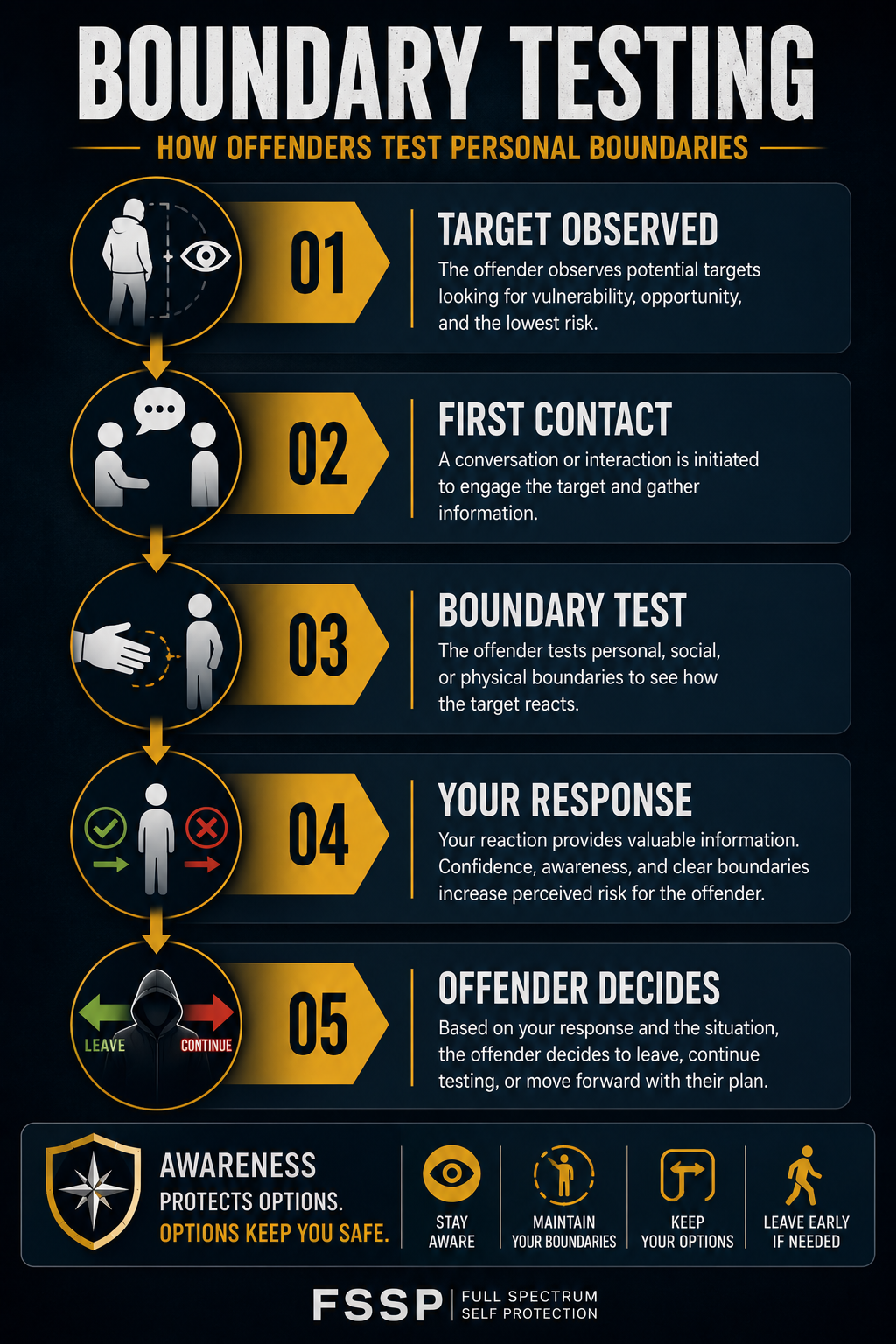
What Is Boundary Testing?
In the study of threat recognition, boundary testing is the process by which an individual intentionally violates or pushes against your personal, social, or physical space boundaries to gauge your reaction. This concept is vital for real-world self-defense and Personal Preparedness. Maintaining personal space is one of the simplest ways to communicate healthy personal boundaries.
When an offender tests your boundaries, they are looking to see if you will actively defend your space, or if you will choose to ignore the intrusion to avoid awkwardness or conflict. Establishing clear boundaries is a critical component of active Situational Awareness. When someone crosses a boundary, it is critical not just to notice the intrusion, but to ask why they did it—especially when analyzed within the surrounding environmental context (learn more in Understanding Your Baseline).
Why Healthy People Respect Boundaries
Healthy social interactions are built on mutual respect. Most people naturally adjust their behavior when they notice that someone feels uncomfortable or asks for more space.
If they accidentally step too close, interrupt you, or cross a social line, they usually apologize, step back, or change their behavior. Respecting boundaries is a normal part of everyday communication.
Someone who repeatedly ignores clear personal boundaries provides additional information—not automatic proof of malicious intent, but a clear reason to pay closer attention and reassess the situation.
Free Training Video: Learn the Fence
One practical way to communicate clear personal boundaries without appearing aggressive is The Fence—a non-threatening protective position that helps you maintain distance, preserve reaction time, and clearly signal awareness without escalating the situation.
Watch the Free Video →Why Offenders Test Boundaries
Predatory offenders seek to reduce their own risk of failure, resistance, or detection. By violating boundaries, offenders seek to test whether you are alert (in a state of readiness like the Cooper Color Code Orange) or distracted and compliant. They test boundaries because it helps them establish:
- •Compliance: Will you quietly tolerate small encroachments, or will you stand your ground?
- •Assertiveness: Do you possess the confidence to say "no" and manage your space, or do you freeze?
- •Leverage: Can they use social conditioning, guilt, or politeness to manipulate you into letting down your guard?
- •Isolation: Can they slowly cut off your access to exits or helper networks without you raising an alarm?
Common Examples
Boundary tests are often subtle and can easily be excused as mere rudeness or accident. Look for these behaviors:
- •Unusually Close Proximity: Stepping inside your personal bubble when there is plenty of room to pass.
- •Blocking Paths: Placing themselves in a corridor or exit route to restrict your movement.
- •Ignoring "No": Continuing to pitch a service, ask questions, or close distance after you decline.
- •Physical Contact: Touching your arm, shoulder, or back without your permission.
- •Intrusive Questions: Asking for details about your hotel, plans, or whether you are alone.
- •Pressuring Decisions: Using urgency to force compliance before you can fully process context.
Why People Ignore Boundary Tests
Predictably, many people overlook boundary violations. The biggest factor is social conditioning. From a young age, we are taught to be polite, helpful, and avoid causing scenes. Predatory actors exploit these exact rules of politeness and conflict avoidance to get close to their targets.
If you feel that correcting a boundary violation makes you look "rude" or "paranoid," you are letting social conditioning override your natural self-protection system. Trust your intuition—it is the ultimate warning system.
Your Response Matters
Your response to a boundary push provides an observer with vital information about your readiness. Offenders are looking for targets who show passive compliance rather than active awareness.
By enforcing your personal space early, you signal that you are not an easy target. Maintaining your stride, moving away, and speaking clearly increases the offender's perceived risk, which frequently halts their plan early in the timeline (learn more in our guide on Victim Selection).
Practical Scenario: The Coffee Shop Space Intrusion
Practical Scenario: The Coffee Shop Space Intrusion
You are waiting in line at a cafe. A stranger repeatedly steps into your personal space despite ample room around you. You take a step forward to create distance. They immediately move closer again.
Evaluate the pattern:
- Was the physical intrusion accidental or persistent?
- Did they adjust or ignore your attempt to reset space?
- Does the behavior stop when noticed, or escalate?
Context Changes Everything
Just as with the Criminal Interview, context determines meaning. A person bumping into you on a packed subway during rush hour is normal. That same person pressing against you in an empty parking garage is a critical threat indicator that represents a clear anomaly in behavior.
Always evaluate space violations using the following environmental factors:
- •Crowd Density: Is there space for the person to maintain distance?
- •Location: Transitional spaces are high-risk locations for boundary tests.
- •Time: Isolated settings at night increase the severity of boundary violations.
- •Behavior Over Time: Does the person adjust their path to follow yours?
Practical Strategies
You can manage your boundaries calmly and effectively without starting a conflict:
- •The Fence: Use The Fence to communicate clear boundaries while maintaining distance.
- •Maintain Distance: Step away to reset your space bubble early. Don't wait for them to get closer.
- •Clear Language: Say "I need some space" or "Please step back." Speak with a firm, confident voice.
- •Skip Justifications: You do not need to explain why you want space. A simple "No, thank you" is sufficient.
- •Keep Moving: Walk toward areas with people, exits, or active surveillance.
- •Check Hands: Watch for Hidden Hands and scanning behaviors that indicate threat intent.
Common Mistakes
Avoid these typical self-protection errors:
- •Politeness Priority: Letting a stranger stand too close because you don't want to seem rude.
- •Ignoring discomfort: Dismissing a gut warning signal that something isn't right.
- •Delaying action: Waiting to see "what happens next" before moving to a safer location.
Key Takeaways
Key Takeaways
- Boundaries communicate confidence and awareness long before conflict.
- Some offenders use boundary intrusions specifically to evaluate target compliance.
- Your reaction provides critical information to an observer.
- Environmental context always dictates whether a boundary push is accidental or intentional.
- Maintaining distance and keeping options open is safer than proving someone wrong.
Frequently Asked Questions
Boundary testing is a behavioral diagnostic technique used by some offenders to check a target's willingness to comply, react, or enforce personal space boundaries before committing to a crime.
No. Many space intrusions in crowded cities or public transport are accidental. Evaluating context (empty space vs. crowded space) and response feedback (whether the intrusion is corrected or repeated) helps identify deliberate boundary tests.
Offenders test boundaries to reduce their own risk. By executing small intrusions (e.g., stepping too close or touching someone's shoulder), they observe whether the target reacts assertively or complies passively, indicating vulnerability.
Correct space early and calmly. Step back, make direct eye contact, keep your hands up in a natural talking posture, and declare your space verbally if necessary. Do not feel obligated to explain or justify your actions.
No. In the vast majority of cases, a firm, polite, and confident boundary assertion causes the offender to select a different, less difficult target. Predatory offenders seek easy opportunities, not active resistance.
Continue Your Training
Continue Your Training
Recognizing boundary tests is only one part of understanding human behavior. The next step is learning how to recognize the physical and behavioral cues (Pre-Attack Indicators) that appear right before violence occurs.
Continue to: Pre-Attack Indicators →