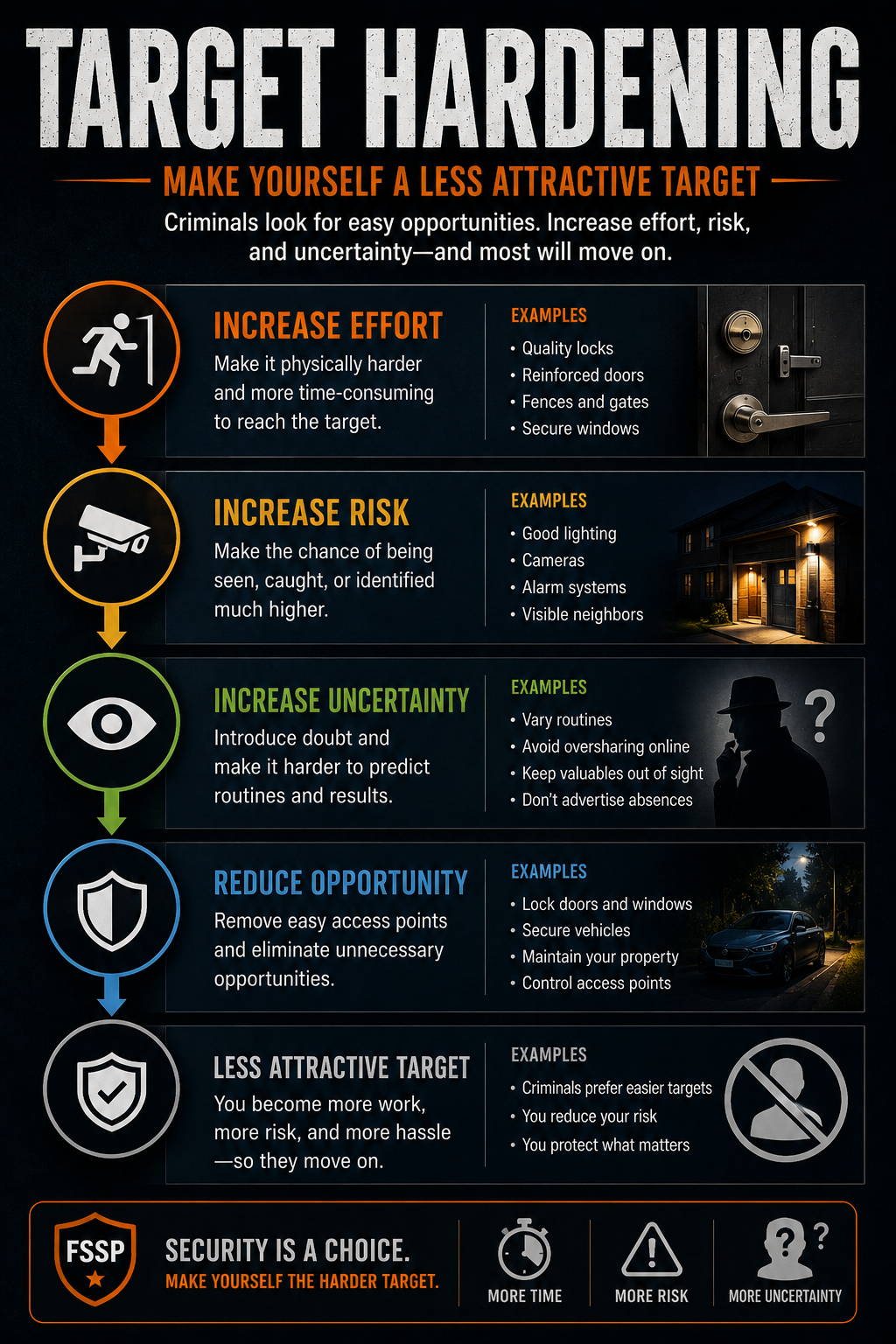
What Is Target Hardening?
In the field of crime prevention, target hardening refers to the process of making people, property, or assets more difficult, risky, or time-consuming to target. The objective is not to design an impenetrable vault, but to systematically reduce criminal opportunity. By implementing appropriate security measures, you alter the cost-benefit calculation that potential offenders make when selecting a target. When a target requires too much time, noise, or effort, or carries a high risk of detection, offenders will almost always look for an easier opportunity.
Target hardening is one of the most widely used principles in crime prevention because it focuses on reducing opportunities rather than reacting after an incident occurs.
Target Hardening Is About Influence—Not Control
Target hardening does not allow you to control another person's decisions. Instead, it helps influence the conditions under which those decisions are made. By increasing effort, uncertainty, and perceived risk, you encourage someone looking for an easy opportunity to move on. The goal is reducing opportunity—not guaranteeing outcomes.
Opportunity Matters
The vast majority of crimes—especially property crimes like burglary, auto theft, and opportunistic theft—are driven by opportunity. Offenders weigh four primary factors when evaluating a target:
- Effort: How physically hard is it to breach the barrier or take the asset?
- Time: How long will it take to complete the act and escape?
- Visibility: Can the act be performed out of sight, or is it exposed to observation?
- Uncertainty & Risk: What is the likelihood of being interrupted, caught, or identified?
Effective target hardening, including structured burglary prevention, aims to maximize the effort and risk while minimizing the visibility for the offender, forcing them to reconsider the target's viability.
How Effective Is Target Hardening?
Target hardening can be effective because many offenders select targets based on accessibility, effort, perceived risk, time required, and likelihood of detection. By systematically increasing these obstacles, you directly influence the offender's decision-making process, often prompting them to abandon the attempt and look elsewhere.
However, target hardening does not guarantee safety. Its purpose is to increase friction and reduce opportunity, especially when multiple security measures are layered together to address vulnerabilities from multiple angles.
Target Hardening Is More Than Physical Security
While target hardening often involves physical security hardware like locks, deadbolts, and security grilles, equipment is only one part of the system. True target hardening is built on a foundation of behavioral habits, routines, and situational awareness. Having the best deadbolt in the world is useless if you forget to lock it, leave a window open, or publish your travel plans on social media. Real security is an integration of hardware, software, habits, and situational awareness (which you can learn more about in What Is Situational Awareness?).
Think Like an Opportunist
To harden your targets effectively, you must learn to look at your life and property through the eyes of an opportunist. This is similar to understanding the principles of Victim Selection, where criminals look for cues of vulnerability. Ask yourself:
- Which home on the street looks like it is currently unoccupied?
- Which vehicle has valuables left in plain sight on the dashboard?
- Which person in the crowded subway station is completely distracted by their phone?
Identifying these vulnerability indicators in your own life allows you to patch them before someone else exploits them.
This is closely related to Victim Selection. Understanding how opportunities influence behavior allows you to reduce the factors that may make you or your property appear more attractive than other available options.
Small Changes Create Big Results
You don't need to spend thousands of dollars to significantly harden your security. High-impact target hardening actions include:
- Replacing short screws in door strike plates with 3-inch screws to secure the door directly to the structural studs.
- Securing side gates with high-quality padlocks to prevent backyard entry.
- Keeping bushes and trees trimmed below window level to prevent hidden approaches.
- Leaving a light on or using automated timers to simulate occupancy when you are away.
- Parking in well-lit, visible spaces rather than dark corners.
- Securing digital accounts using multi-factor authentication (MFA) and strong passwords.
- Verifying identities at the door before unlocking or opening it.
Target Hardening Your Home
Target hardening your home is not about turning a private residence into an impenetrable fortress. Instead, the goal is to systematically increase the effort and risk of detection for an intruder while drastically reducing easy opportunities.
Effective residential target hardening relies on layered security rather than a single protective measure. Practical steps include reinforcing exterior doors and deadbolts, installing reliable window locks on ground-level openings, and maintaining good exterior lighting with clear sightlines around entry points. Simple habits—such as securing side gates and avoiding obvious indicators that the house is unoccupied—create friction that encourages opportunistic offenders to move on.
By establishing overlapping deterrents, you make unauthorized access significantly more difficult, time-consuming, and noisy without compromising your daily quality of life.
Target Hardening Everywhere
These principles apply universally across all environments:
- At Home: Implementing physical delay layers (quality locks, security film) and environmental visibility (lighting, line of sight), which forms the core of a Layers of Security framework.
- While Traveling: Avoiding predictable routines, keeping valuables out of sight in vehicles, and locking hotel doors immediately (detailed in Travel Smart, Stay Safe, Hotel Security, and Vehicle Security).
- In Public: Maintaining awareness of your surroundings, avoiding distraction, and securing personal bags.
- Online: Securing personal data, using password managers, and avoiding sharing sensitive information (detailed in Digital Security).
Target Hardening Checklist
Use this practical target hardening checklist to evaluate and improve your overall security posture across home, daily routines, travel, and digital environments:
1. Home & Physical Security
- Reinforce exterior door frames by replacing standard screws with 3-inch structural screws in strike plates.
- Ensure ground-level windows and sliding doors feature working secondary locks or security film.
- Maintain exterior motion lighting around entryways and eliminate dark blind spots.
- Keep side gates locked and maintain clear sightlines by trimming overgrown landscaping.
2. Personal & Behavioral Habits
- Establish consistent locking routines for all doors and windows, even when at home.
- Practice active situational awareness in public spaces instead of being distracted by mobile devices.
- Keep bags, wallets, and personal valuables secure and out of public view.
3. Travel & Vehicle Security
- Never leave laptops, bags, or visible items inside a parked vehicle.
- Lock hotel room deadbolts and security latches immediately upon entry.
- Vary daily travel routes and schedules when in unfamiliar environments.
4. Digital & Online Protection
- Enable multi-factor authentication (MFA) on all primary email, financial, and personal accounts.
- Use unique, complex passwords generated and managed via a password manager.
- Avoid sharing real-time location updates or travel itineraries on social media.
Common Mistakes to Avoid
Avoid these typical mistakes when attempting to harden your security:
- Relying on one product: Buying a video doorbell and assuming your home is fully protected.
- Ignoring daily habits: Leaving side doors unlocked or keeping keys in obvious hiding places near the entrance.
- Spending without a security plan: Purchasing random gadgets instead of building an integrated, layered security plan.
- Assuming "it won't happen here": Neglecting basic precautions due to a false sense of safety.
- Neglecting digital security: Securing your physical home while leaving your digital assets easily accessible.
Practical Scenario: Comparing Opportunity & Risk
Two identical vehicles are parked on the same street overnight.
Car A: Unlocked door, laptop visible on the passenger seat, parked in an unlit corner.
Car B: Nothing visible inside, parked beneath a bright streetlight, steering wheel lock installed, visible alarm sticker.
The Result:
Neither vehicle is completely theft-proof, but Car B requires vastly more effort, noise, and time while offering high risk of detection. Opportunistic offenders will naturally choose the easier path.
Key Takeaways
- Target hardening systematically reduces criminal opportunity.
- Small, practical improvements often produce better protection than one expensive device.
- Effective security relies heavily on daily behavioral habits and awareness.
- Integrated layers create friction and uncertainty for an offender.
- The primary goal is pragmatic risk reduction, not impossible perfection.
Frequently Asked Questions
Target hardening is the practice of strengthening the security of a building, installation, person, or asset to make it a more difficult, risky, or time-consuming target for criminals. The goal is to discourage unwanted behavior by altering the risk-reward equation.
Most criminals are opportunists looking for easy, low-risk targets. Target hardening increases the effort required to breach a target, the noise and time involved, and the likelihood of being caught. This shifts the calculation, prompting the offender to abandon the attempt.
Simple, high-impact actions include installing long screws in door strike plates to reinforce frames, adding security film to windows, improving exterior lighting, locking side gates, keeping valuables out of sight, and establishing consistent locking habits.
Yes. While traveling, target hardening means staying aware in public, avoiding predictable schedules, keeping valuables secure, and locking hotel doors. Online, it involves using unique, strong passwords, multi-factor authentication (MFA), and keeping personal information private.
A target hardening checklist includes physical home security measures (reinforcing door strike plates, window locks, exterior lighting), personal behavioral habits (consistent locking routines, awareness in public), travel precautions (securing hotel doors, hiding vehicle valuables), and digital security (multi-factor authentication and strong passwords).
Continue Your Training
Understanding target hardening is only one part of effective security. Next, learn how these principles can be applied around your home by identifying and eliminating blind spots before they become vulnerabilities.
Continue to: Home Security – Blind Spots →