Introduction: The Moment Everything Changes
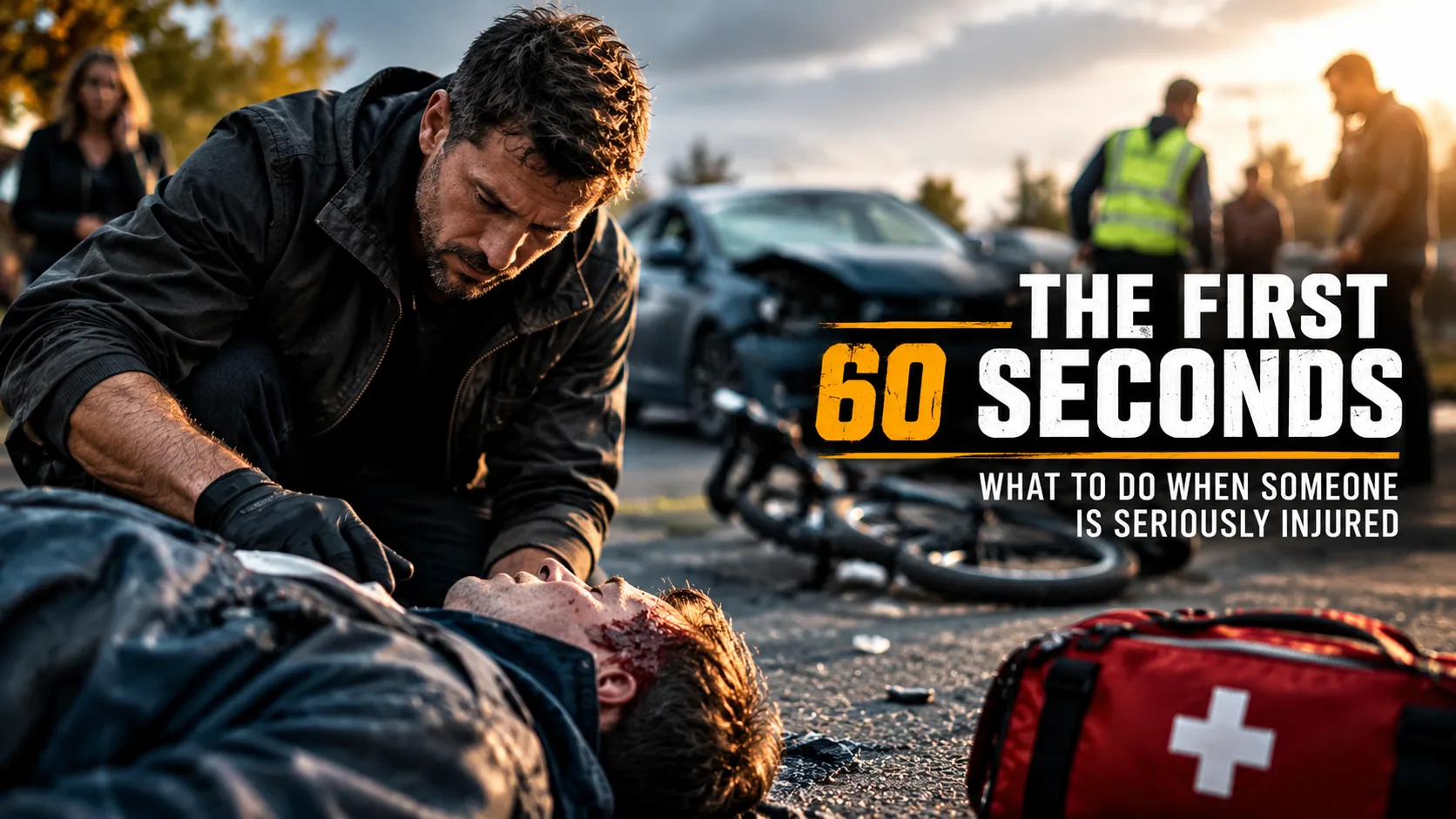
Imagine walking through a parking lot on an ordinary afternoon.
A few meters ahead, a cyclist collides with a turning vehicle.
You hear the impact.
The bicycle hits the ground. The rider lands hard on the pavement. For a moment, nobody moves.
Then everything happens at once.
Someone screams. A driver gets out of the vehicle. Two people approach the injured cyclist. Another person takes out a phone.
You are standing only a few meters away.
What do you do?
Most people have a general idea of what first aid involves. They know about CPR, bandages, and calling an ambulance.
But knowing individual techniques is not the same as knowing what to do first.
In a real emergency, you are rarely presented with a clean, organized situation.
You encounter uncertainty.
You may not know what happened. You may not know how badly someone is injured. Other people may be panicking, shouting instructions, or doing nothing at all.
And you may have only seconds to recognize a life-threatening problem.
The first minute is not about doing everything. It is about identifying what cannot wait.
That is the central principle of this guide.
We are going to examine the decisions that matter during the first sixty seconds of a serious injury, how to prioritize immediate threats to life, and how an ordinary bystander can provide meaningful assistance before emergency responders arrive.
Not through heroics.
Through awareness, structured thinking, and decisive action.
1. Why the First Minute Matters
When someone is seriously injured, the most obvious injury is not always the most dangerous one.
A broken arm may look dramatic.
A person screaming in pain may attract everyone's attention.
Meanwhile, someone who is unconscious and not breathing normally may be in immediate danger of death.
Another casualty may be losing a critical amount of blood without making any noise at all.
This creates a fundamental problem.
Human attention is naturally drawn toward what is dramatic, not necessarily toward what is most urgent.
In emergency care, however, priorities must be determined by the threat to life.
That means distinguishing between:
- Injuries that are painful but not immediately life-threatening.
- Conditions that may deteriorate and require urgent medical attention.
- Conditions that require immediate intervention to prevent death.
For an untrained bystander, this distinction does not require a complete medical diagnosis.
It requires recognizing a small number of critical warning signs.
A person who is unresponsive and not breathing normally needs immediate resuscitation.
Severe, life-threatening external bleeding requires immediate control.
A dangerous environment must be addressed before rescuers expose themselves to the same hazard.
And emergency medical services must be activated as quickly as possible.
These are the foundations of effective action.
Sixty seconds is a framework, not a deadline
The title of this article is deliberately focused on the first minute.
But that does not mean every emergency follows a fixed sixty-second sequence.
Some situations require immediate action within seconds.
Others allow more time for assessment.
If a person is in cardiac arrest, for example, do not delay CPR to complete an arbitrary checklist.
If someone has catastrophic external bleeding, do not wait for a full examination before controlling it.
The purpose of the sixty-second framework is to prevent hesitation and confusion.
It is a decision-making tool, not a stopwatch.
2. Before You Touch the Casualty: Is the Scene Safe?
One of the most important principles in emergency response is also one of the easiest to forget.
A rescuer who becomes another casualty cannot help the original victim.
Imagine approaching someone lying in the road after a collision.
You are focused on the injured person.
But traffic is still moving.
A driver approaching from behind may not see you.
Or imagine finding someone unconscious in a workshop.
You rush inside without noticing a strong chemical smell or an electrical hazard.
Your intention is to help.
Your actions may make the situation worse.
The rapid scene safety assessment
Before approaching, look for immediate hazards.
Consider:
- Moving vehicles and unstable traffic conditions.
- Fire, smoke, or suspected hazardous gases.
- Exposed electricity or damaged electrical equipment.
- Falling objects, unstable structures, or broken glass.
- Water, machinery, or other environmental hazards.
- Ongoing violence or a person who may still pose a threat.
This does not mean spending minutes conducting a formal risk assessment.
It means taking a brief, deliberate look before entering the scene.
Do not confuse courage with unnecessary exposure
You are not expected to enter a burning building, approach live electrical equipment, or intervene in ongoing violence to provide first aid.
If the scene is unsafe, maintain distance, call emergency services, describe the hazards, and follow the dispatcher's instructions.
If the environment is safe enough to approach, proceed.
Should you move an injured person?
Unnecessary movement can worsen certain injuries.
However, leaving someone in an immediately dangerous location can also be harmful.
As a general rule, avoid moving a seriously injured person unless movement is necessary to escape immediate danger, provide essential lifesaving care, or follow emergency dispatch instructions.
If you suspect a spinal injury, minimize unnecessary head, neck, and body movement.
But remember that airway and breathing emergencies take priority over immobilization.
Scene safety is not a reason to hesitate indefinitely. It is the first condition for helping effectively.
3. The Bystander Problem: When Everyone Waits for Someone Else
There is another challenge that has nothing to do with medical knowledge.
It is human behavior.
When several people witness an emergency, responsibility can become strangely unclear.
Everyone sees the injured person.
Everyone knows something should happen.
But nobody is certain who is supposed to act.
This is commonly described as diffusion of responsibility.
In practical terms, it means that a group of people can sometimes respond less effectively than a single person who accepts a clear task.
Break the pattern
You do not need to become the commander of the scene.
But you can establish a few simple actions.
For example:
"Call an ambulance. Tell them exactly where we are."
"You in the blue jacket, please get the AED from the building."
"Please keep people away from the road."
Clear instructions are often more effective than shouting:
"Somebody do something!"
Assign tasks to specific people.
Make eye contact where possible.
Ask for confirmation.
And if nobody is calling emergency services, make the call yourself.
Why specific instructions matter
People under stress may have difficulty deciding what to do.
A concrete instruction reduces that burden.
"Call 112 and tell them we have an unconscious person who is not breathing normally" provides a much clearer action than "Get help."
In the United States and Canada, the general emergency number is 911. In the European Union, 112 connects callers to emergency services. Other countries may use different numbers.
Know the emergency number wherever you live or travel.
4. Recognize the Immediate Threats to Life
You do not need to identify every injury.
You need to recognize the conditions that require immediate action.
For a lay rescuer, three priorities are especially important:
- 1. Catastrophic external bleeding.
- 2. Unresponsiveness and abnormal or absent breathing.
- 3. Immediate environmental threats that prevent safe care.
These problems may occur individually or together.
The correct order of action depends on what you find and whether other helpers are available.
Catastrophic bleeding
Severe external bleeding can be fatal within minutes.
Warning signs may include:
- Blood flowing rapidly or spurting from a wound.
- Blood continuously pooling on the ground.
- Clothing becoming rapidly soaked with blood.
- Traumatic amputation.
- Severe bleeding that does not stop with ordinary pressure.
A person can be conscious and speaking while losing a dangerous amount of blood.
Do not assume that someone is safe simply because they are talking.
Unresponsiveness
An unresponsive person requires immediate assessment.
Speak loudly and gently tap their shoulders.
If they do not respond, call for help and assess breathing.
Abnormal breathing
A person who is not breathing normally may be in cardiac arrest.
Occasional gasps, irregular snorting sounds, or agonal breathing are not normal breathing.
Do not mistake gasping for evidence that circulation is adequate.
If an adult is unresponsive and not breathing normally, activate emergency services, obtain an AED if available, and begin CPR immediately.
Multiple immediate threats
A person may have both severe bleeding and cardiac arrest.
If other people are available, tasks can happen simultaneously: one person controls catastrophic bleeding while another initiates emergency communication and resuscitation.
If you are alone, act according to the most immediate findings and follow emergency dispatcher guidance.
The goal is not to perform a perfect sequence.
The goal is to address life-threatening conditions without avoidable delay.
5. The First 60 Seconds: A Practical Decision Framework
Let us organize these priorities into a simple model.
Remember that the times below are illustrative. They overlap, and urgent lifesaving action always takes precedence over the schedule.
Seconds 0–10: Recognize and orient
Something has happened.
Do not immediately rush forward without looking.
Identify the casualty's location and any obvious danger.
Ask yourself:
- Is it safe to approach?
- Is the person moving or responding?
- Is there obvious severe bleeding?
- Are other people already helping?
If the scene is unsafe, remain at a safe distance and contact emergency services.
If it is safe, approach promptly.
Seconds 10–20: Establish responsiveness and identify obvious bleeding
Speak to the injured person.
"Can you hear me?"
"Are you okay?"
Check for a response.
Look for catastrophic external bleeding.
If severe bleeding is present, apply firm direct pressure immediately, or direct another person to do so.
If the person is unresponsive, immediately assess breathing.
Seconds 20–30: Activate emergency assistance
If emergency services have not already been contacted, call now.
Use your phone's speaker function when practical so you can continue helping while speaking with the dispatcher.
State:
- The exact location.
- What happened, if known.
- How many people are injured.
- Whether someone is unconscious or not breathing normally.
- Whether there is severe bleeding.
- Any hazards affecting access.
Do not delay lifesaving care merely to give a lengthy explanation.
Follow the dispatcher's instructions.
Seconds 30–45: Begin the critical intervention
Your next action depends on the casualty's condition.
If the person is unresponsive and not breathing normally, start CPR and arrange for an AED.
If severe external bleeding is present, continue effective bleeding control.
If the person is unconscious but breathing normally, maintain an open airway, monitor breathing, and use an appropriate recovery position when indicated and safe.
If the casualty is conscious and breathing normally, continue assessing for serious injuries and monitor for deterioration.
Seconds 45–60: Stabilize the response
Confirm that emergency services have been contacted.
Ensure the most urgent intervention is continuing.
Ask someone to retrieve the AED or first-aid equipment if needed.
Direct bystanders away from hazards.
Prepare to give responders accurate information.
Do not stop helping simply because the first minute has passed.
The first minute establishes the response. It does not complete it.
6. Severe Bleeding: Stop the Loss Before It Becomes Irreversible
One of the most time-critical traumatic emergencies is catastrophic external hemorrhage.
The human body requires circulating blood to deliver oxygen to organs and tissues.
When severe bleeding continues unchecked, that system can fail rapidly.
Direct pressure
For severe external bleeding, immediately apply firm, continuous pressure directly to the bleeding site using a suitable dressing, clean cloth, or your hands if necessary.
Use protective gloves when available, but do not allow the search for gloves to cause a dangerous delay.
Maintain pressure.
Do not repeatedly lift the dressing to check the wound.
If possible, have another person call emergency services while you control the bleeding.
Tourniquets
For life-threatening bleeding from an arm or leg, a commercially manufactured tourniquet may be appropriate.
Use a suitable device and follow your training and its instructions.
A tourniquet should be tightened until the life-threatening bleeding stops.
Record the application time if possible, and do not loosen or remove it yourself unless directed by qualified medical personnel.
Tourniquets are not used for bleeding from the torso, neck, or other areas where they cannot be applied appropriately.
Wound packing
For certain severe wounds where a tourniquet cannot be used, wound packing with suitable gauze may be an option for trained responders.
It requires practical instruction and should not be improvised without understanding the technique and anatomical risks.
Why practical training matters
Reading about hemorrhage control is useful.
But recognizing severe bleeding, applying effective pressure, and using a tourniquet correctly are skills that benefit greatly from hands-on training.
This is why FSSP treats critical bleeding control as a separate, dedicated subject.
Related FSSP article: Critical Bleeding Control — The Injury You Cannot Afford to Ignore.
7. Unconscious and Not Breathing Normally: Start CPR
Not every unconscious person is in cardiac arrest.
But an unresponsive person who is not breathing normally must be treated as a possible cardiac arrest.
Recognize the emergency
Check responsiveness.
If there is no response, assess whether the person is breathing normally. Do not spend more than about ten seconds trying to determine this.
Gasping is not normal breathing.
If you are unsure whether breathing is normal, emergency dispatchers can guide you.
Begin chest compressions
For an adult in suspected cardiac arrest:
- Place the person on their back on a firm surface when possible.
- Position your hands in the center of the chest.
- Push hard and fast at approximately 100–120 compressions per minute.
- Aim for a compression depth of about 5–6 cm.
- Allow the chest to recoil fully between compressions.
- Minimize interruptions.
If you are trained and willing to provide rescue breaths, use the appropriate CPR sequence taught in your current training, commonly 30 compressions followed by 2 breaths for adults.
If you are untrained or unable to provide breaths, continuous hands-only chest compressions are an important alternative for adult sudden cardiac arrest.
Children, infants, drowning casualties, and some other emergencies have different resuscitation considerations. Follow your training and dispatcher instructions.
Use an AED
An automated external defibrillator can analyze heart rhythm and deliver a shock when indicated.
If an AED is available, switch it on and follow its spoken and visual instructions.
Do not delay CPR while waiting for someone to retrieve the device.
When multiple rescuers are available, one can continue CPR while another obtains and prepares the AED.
An AED is designed to guide users through its operation.
You do not need to diagnose the heart rhythm yourself.
Continue until help takes over
Continue resuscitation until emergency professionals take over, the person shows clear signs of life, the scene becomes unsafe, or you are physically unable to continue.
Follow the emergency dispatcher's guidance.
8. Unconscious but Breathing Normally: Protect the Airway
An unconscious person who is breathing normally still requires urgent attention.
Loss of consciousness can compromise the person's ability to protect their airway.
Vomiting, blood, or the position of the head may interfere with breathing.
Call emergency services and continue monitoring.
When appropriate, place the person in a recovery position to help maintain an open airway.
However, significant trauma or suspected spinal injury requires additional care to minimize unnecessary movement.
If the airway cannot be maintained without repositioning, airway management takes priority. Follow dispatcher instructions where possible.
Do not give an unconscious person food, water, or medication by mouth.
Reassess breathing frequently.
If normal breathing stops, begin CPR.
A casualty's condition can change. An initial assessment is never the end of the process.
9. Communication: The Information That Actually Matters
Calling emergency services is not simply reporting that something bad happened.
It is providing information that allows responders to send the right assistance.
A useful emergency call answers five questions.
Where are you?
Give the most precise location available.
A street address is ideal, but landmarks, road numbers, kilometer markers, building entrances, or GPS coordinates may be necessary.
If you are inside a large building, specify the floor, entrance, and access route.
What happened?
Describe what you observed.
For example:
"A cyclist was struck by a vehicle."
Avoid speculation about injuries or causes.
How many people are injured?
If known, provide the number of casualties.
Mention if more than one person may require immediate attention.
What is their condition?
This is often more important than describing visible injuries in detail.
Examples:
"One person is unconscious and not breathing normally."
"One person has severe bleeding from the leg."
"The person is awake and speaking but cannot stand."
Are there ongoing hazards?
Tell the dispatcher about traffic, fire, electrical hazards, violence, or other risks.
Stay on the line and follow instructions unless directed otherwise.
If you have assigned the call to another bystander, verify that the call has actually been made.
Assumption is not confirmation.
10. Stress, Tunnel Vision, and the Failure of Attention
Emergencies do not merely challenge our knowledge.
They challenge our ability to access that knowledge under pressure.
An unexpected injury can produce a powerful stress response.
Your heart rate may increase.
Your attention may narrow.
You may become fixated on a single detail.
You may struggle to remember something you understood perfectly during training.
These reactions vary between individuals, but they are common enough to matter in emergency preparation.
The problem with tunnel vision
Imagine seeing a person with a visibly broken leg.
The deformity is obvious.
You immediately focus on stabilizing the limb.
But you fail to notice that the person is also bleeding heavily from another wound.
Your attention has been captured by the most visually striking problem.
This is why structured priorities matter.
They help redirect attention toward the conditions that threaten life.
A simple mental reset
When the situation permits, use a brief internal sequence:
SAFE — RESPONSIVE — BREATHING — BLEEDING — HELP.
This is a memory aid, not a replacement for formal first-aid algorithms.
The elements are not always sequential: catastrophic bleeding and abnormal breathing may require immediate, parallel action.
The purpose is to prevent fixation and restore a basic structure to your thinking. (Learn how evaluating environmental cues prevents blind spots in Understanding Your Baseline).
Action reduces uncertainty
You may not know exactly what happened.
You may not know the casualty's diagnosis.
You may not know how long the ambulance will take.
But you can still perform useful actions.
Assess the scene.
Recognize an immediate threat.
Call for help.
Start the appropriate intervention.
Reassess.
Competence does not require knowing everything.
It requires knowing what matters next.
11. The Difference Between a Single Casualty and Multiple Casualties
Helping one injured person is challenging enough.
Helping several people introduces a different problem.
Resources become limited.
There may not be enough rescuers, equipment, or time to address every injury simultaneously.
This is where the distinction between ordinary first aid and mass-casualty management becomes important.
Do not simply help the loudest person first
A person screaming in pain may be seriously injured.
But a quiet, unresponsive person may have a more immediate threat to life.
This does not mean ignoring conscious casualties.
It means avoiding the assumption that visible distress always indicates the highest priority.
Your role as an ordinary bystander
Do not attempt to perform professional triage beyond your training.
Instead:
- Ensure your own safety.
- Contact emergency services immediately.
- Report the number and apparent condition of casualties.
- Follow dispatcher instructions.
- Address immediately recognizable life threats within your abilities.
- Use other capable bystanders to help when safe.
Formal triage systems require appropriate training and operate within specific emergency-response procedures.
For a deeper examination of resource allocation and casualty prioritization, see the FSSP article Mass Casualty Basics: Managing the Unmanageable.
12. A Realistic Scenario: A Serious Injury Outside a Supermarket
Let's return to an ordinary environment.
It is Saturday afternoon.
You are leaving a supermarket when an older man collapses near the entrance.
He falls backward and hits the pavement.
Several people turn toward him.
One person says, "He probably fainted."
Another begins searching for a bottle of water.
You approach.
The first decision
You check the surroundings.
There is no immediate traffic or other obvious danger.
You kneel beside the man and speak loudly.
"Sir, can you hear me?"
No response.
You gently tap his shoulders.
Still nothing.
The second decision
You ask a nearby person to call emergency services and put the phone on speaker.
You ask another person to find the nearest AED.
You assess breathing.
The man makes an occasional gasping sound, but he is not breathing normally.
The third decision
You recognize that gasping may indicate cardiac arrest.
You begin chest compressions.
The person making the emergency call relays the dispatcher's instructions.
Another bystander retrieves an AED from inside the supermarket.
You continue CPR while the AED is prepared.
What did you not do?
You did not give the man water.
You did not spend time debating whether he had fainted.
You did not assume that gasping meant he was breathing adequately.
You did not wait for a doctor to arrive before beginning CPR.
And you did not try to diagnose the underlying cause.
What made the difference?
You recognized the immediate problem.
You assigned clear tasks.
You activated emergency services.
And you began an appropriate lifesaving intervention.
The outcome of a cardiac arrest can never be guaranteed.
But rapid recognition, early CPR, and prompt AED use are essential links in the chain of survival.
The first minute mattered because it established the right priorities.
13. The First Responder Mindset: What You Can Control
There is a dangerous misconception about emergency response.
People sometimes believe that they must remain completely calm to be effective.
That is not necessarily true.
You may feel frightened.
Your hands may shake.
Your voice may sound different.
You may be aware that the situation is serious.
None of that automatically prevents you from helping.
The important distinction is between emotional discomfort and functional incapacity.
You do not need to eliminate fear.
You need a structure that allows you to act despite it.
Focus on the next useful action
Instead of thinking:
"What if I do something wrong?"
Ask:
"What is the most important thing I can do right now?"
Sometimes the answer is calling emergency services.
Sometimes it is applying direct pressure to a severe bleed.
Sometimes it is beginning CPR.
Sometimes it is remaining at a safe distance because the environment is dangerous.
Avoid the hero mentality
Your role is not to demonstrate courage.
Your role is to improve the casualty's chances without creating additional harm.
That means recognizing your limits.
It means using available help.
And it means accepting that some situations cannot be resolved by a bystander.
You are part of the emergency response.
You are not expected to replace it.
14. Prepare Before the Emergency
The best time to learn lifesaving skills is not while someone is bleeding on the pavement.
Preparedness should begin long before an incident.
Learn practical first aid
Take a recognized first-aid course that includes:
- Recognition of unresponsiveness and abnormal breathing.
- CPR and AED use.
- Severe bleeding control.
- Recovery position and airway management.
- Emergency communication.
- Basic casualty assessment.
Refresh your training periodically.
Recommendations and techniques can change, and practical skills become less reliable without rehearsal.
Know where equipment is located
Do you know where the nearest AED is at your workplace?
Does your gym have a first-aid kit?
Does your vehicle contain basic emergency supplies?
Are those supplies accessible?
Equipment that cannot be located quickly has limited value.
Practice communication
In a training exercise, ask someone to simulate an emergency call.
Can you explain the location clearly?
Can you describe the casualty's condition without unnecessary speculation?
Can you delegate a task to another person?
These are simple skills, but they matter.
Learn to recognize priorities
A first-aid kit is useful.
But recognizing that someone is not breathing normally is more important than knowing which compartment contains the bandages.
Knowledge determines which equipment matters.
15. The First 60 Seconds Checklist
Use this checklist as a learning aid, not as a rigid timed protocol.
Before approaching
- Look for immediate dangers.
- Approach only when it is reasonably safe.
- Identify obvious catastrophic bleeding or unresponsiveness.
Initial assessment
- Check whether the person responds.
- Check breathing promptly if unresponsive.
- Recognize that gasping is not normal breathing.
- Identify life-threatening external bleeding.
Immediate action
- Call emergency services or assign a specific person to call.
- Begin CPR for an unresponsive person who is not breathing normally.
- Obtain and use an AED as soon as available.
- Apply firm direct pressure to severe external bleeding.
- Use additional bleeding-control techniques only as appropriate to the injury, equipment, and training.
Organize help
- Give bystanders clear, specific tasks.
- Confirm that emergency services have been contacted.
- Keep the scene as safe and accessible as possible.
- Follow dispatcher instructions.
Continue
- Reassess the casualty's condition.
- Continue lifesaving interventions as indicated.
- Monitor breathing if the casualty is unconscious but breathing normally.
- Prepare to hand over accurate information to professional responders.
Remember: If an immediate life threat is present, act on it. Do not wait to finish the checklist.
16. Frequently Asked Questions
17. Final Thoughts: The Most Important Skill Is Knowing What Comes Next
When someone is seriously injured, the situation rarely gives you time to organize your thoughts comfortably.
You may have incomplete information.
You may be surrounded by people who are frightened or confused.
You may not know the full extent of the injuries.
And you may be forced to make decisions before professional help arrives.
That is why the first sixty seconds matter.
Not because you can solve every problem in a minute.
But because you can establish the priorities that shape everything that follows.
Recognize danger.
Protect yourself.
Identify immediate threats to life.
Call for help.
Begin the appropriate intervention.
And continue reassessing.
You do not need to be fearless.
You do not need to be a medical professional.
You need to understand the difference between what looks urgent and what is immediately life-threatening.
In a real emergency, the right action at the right moment matters more than the number of techniques you know.
That is the difference between simply possessing information and being prepared to use it.
And that is what Full Spectrum Self Protection is built around.
Personal Preparedness. For the Real World.
Continue Your Training
This article is part of the FSSP Skills Knowledge Base.
Explore these related subjects:
Critical Bleeding Control: The Injury You Cannot Afford to Ignore
Learn how to recognize life-threatening external bleeding and understand the principles of direct pressure, tourniquets, and wound packing.
Mass Casualty Basics: Managing the Unmanageable
Understand how emergencies change when the number of casualties exceeds immediately available resources.
The Complete Guide to Essential Self Protection Skills
Explore the practical skills and decision-making principles that support personal protection in everyday life.
For deeper training, practical scenarios, and structured self-protection education, explore the FSSP learning platform.
Full Spectrum Self Protection — The Personal Preparedness Company.
Medical guidance and further reading
For publication, the following authoritative resources can support the article's first-aid guidance:
- European Resuscitation Council (ERC): Current basic life support and resuscitation guidance — https://www.erc.edu/
- American Heart Association (AHA): CPR and emergency cardiovascular care guidance — https://cpr.heart.org/
- American Red Cross: First aid, CPR, and AED educational resources — https://www.redcross.org/take-a-class
- STOP THE BLEED: Practical severe bleeding control education — https://www.stopthebleed.org/
Medical disclaimer: This article provides general educational information and does not replace certified first-aid training, professional medical advice, or instructions from emergency dispatchers. Follow current local emergency-response guidelines and the directions of qualified professionals.