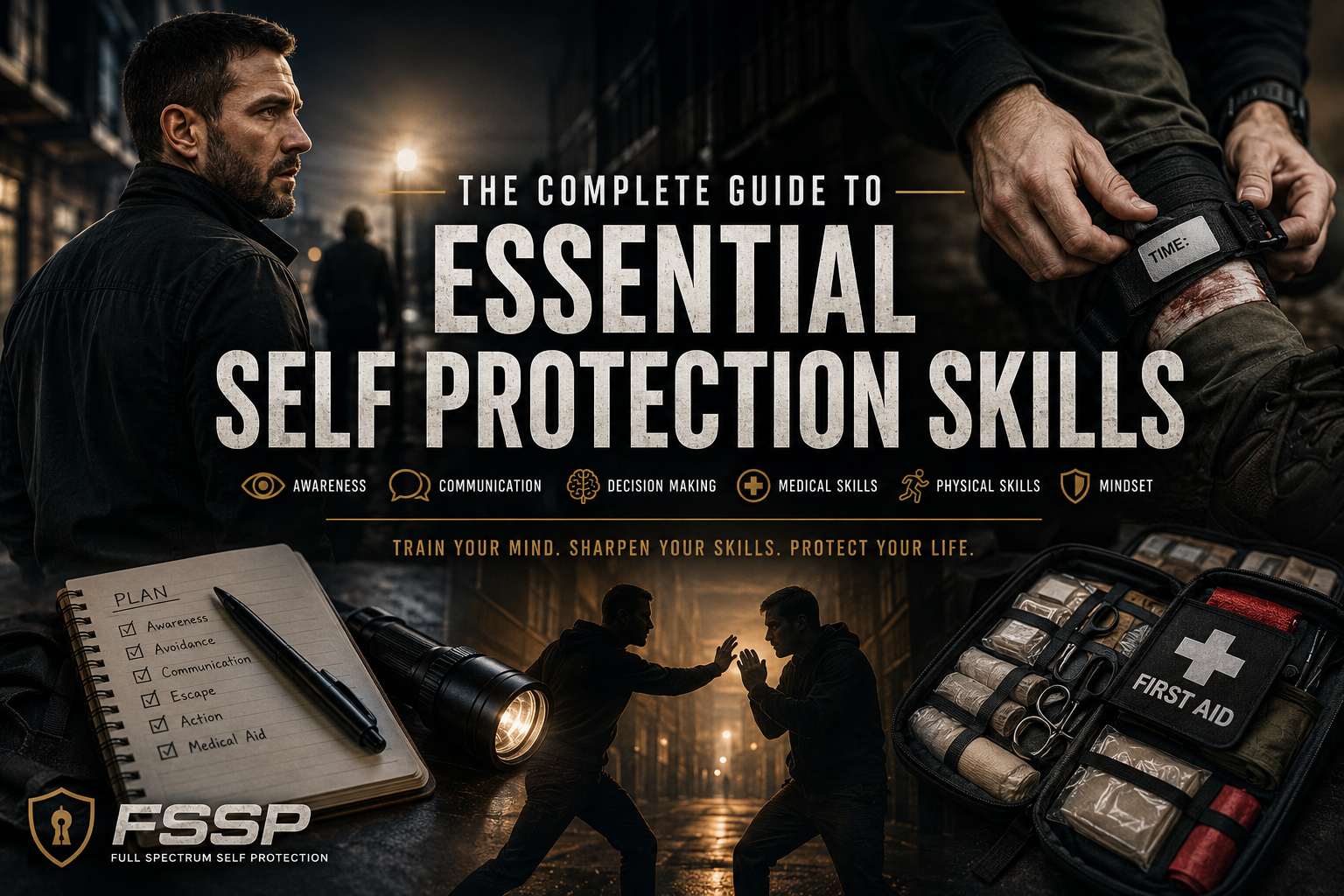
Introduction
When people hear the term self-protection skills, they often think of fighting.
Punches. Kicks. Martial arts.
But violence is only one small part of personal protection.
In reality, the most valuable skills often prevent violence from happening in the first place.
Recognizing danger. Making good decisions. Communicating effectively. Providing first aid. Remaining calm under stress.
The goal of self-protection is not becoming a better fighter.
It is becoming more capable.
What Are Self Protection Skills?
Self-protection skills are practical abilities that improve your ability to prevent, manage and recover from dangerous situations.
Some reduce the likelihood of becoming a victim.
Others improve your ability to respond when prevention fails.
Together, they increase your capability to deal with uncertainty.
Skills vs Equipment
Many people believe buying better equipment automatically makes them safer. It doesn't.
Equipment supports capability. Skills create capability.
A flashlight is useful. Knowing when and how to use it is more valuable.
A first aid kit is important. Knowing how to stop life-threatening bleeding is even more important.
Your skills travel with you. Your equipment may not. Developing these skills is a core aspect of What Is Personal Preparedness?.
The Different Types of Self Protection Skills
Self-protection is multidisciplinary. No single skill solves every problem.
Instead, different abilities complement one another. These protective capabilities complement a broader physical security strategy, as detailed in The Complete Guide to Personal Security.
Situational Awareness
Everything begins with awareness. If you fail to recognize danger early, every other skill becomes more difficult. Developing active Situational Awareness allows you to:
- •Identify unusual behavior.
- •Detect potential threats.
- •Notice changes in your environment.
- •Make better decisions before problems escalate.
Good awareness creates time. And time creates options.
Communication Skills
Many confrontations are influenced by communication.
Your tone. Your body language. Your confidence. Your ability to establish boundaries. Your ability to establish boundaries is a key defense against active Boundary Testing.
Communication is not about winning arguments. It is about influencing outcomes.
Sometimes that means calming a situation. Sometimes it means becoming assertive. Sometimes it means ending the conversation and leaving.
Decision Making Under Stress
Stress changes how we think.
Tunnel vision. Auditory exclusion. Reduced fine motor skills. Memory distortion.
These effects are normal. Training helps us make better decisions despite physiological stress. Prepared decisions are often better than improvised ones.
Medical Skills
Violence is only one reason people get injured. Medical emergencies happen every day.
Basic Medical Skills can save lives long before professional help arrives. Key training includes stopping Severe bleeding, managing airway problems, performing CPR for cardiac arrest, and dealing with burns and fractures.
You do not need to become a paramedic. But everyone benefits from understanding basic emergency care.
Physical Skills
Physical ability remains an important part of self-protection. However, physical techniques should always support a broader strategy.
Good physical skills include:
- •Balance
- •Movement
- •Escaping dangerous situations
- •Protecting vulnerable areas
- •Creating opportunities to disengage
The objective is not winning a fight. The objective is getting home safely.
Observation Skills
Observation is more than simply looking around. It involves recognizing patterns. Identifying anomalies. Understanding human behavior.
Professional observers spend years developing these abilities. Fortunately, anyone can improve them through deliberate practice.
Problem Solving
Every emergency is different. Rigid thinking creates unnecessary risk. Adaptability increases survivability.
Ask yourself:
- •What is happening?
- •What resources do I have?
- •What is my safest option?
- •What happens next?
Good decisions rarely come from panic. They come from clear thinking, which is a foundational element in The Complete Guide to Everyday Preparedness.
Emotional Control
Fear is natural. So are anger and frustration.
The goal is not eliminating emotions. The goal is preventing emotions from controlling your decisions.
Confidence comes from preparation. The better prepared you are, the easier it becomes to remain calm when others panic.
Continuous Learning
Skills deteriorate without practice. Knowledge changes. Threats evolve. Technology advances.
Self-protection should therefore be viewed as a lifelong learning process.
Every new skill increases your capability. Every practice session reinforces confidence. Every lesson improves resilience.
Building Your Personal Skill Set
You do not need to master everything immediately. Start with the fundamentals.
Develop consistent habits. Build one skill at a time. Small improvements accumulate over months and years into significant capability. The objective is progress—not perfection.
Key Principles
Remember these principles:
- •Skills are more valuable than equipment.
- •Prevention is better than reaction.
- •Awareness creates time.
- •Communication solves more problems than force.
- •Physical techniques are only one part of self-protection.
- •Learning never stops.
Final Thoughts
The most capable people are rarely those who know one thing exceptionally well.
They are the people who combine many complementary skills. They observe. They think. They communicate. They prepare. They adapt. And when necessary, they act.
Self-protection is not built upon a single technique. It is built upon continuous development.
Every skill you learn increases your ability to protect yourself and those around you. Because true capability is never defined by what you own. It is defined by what you can do.