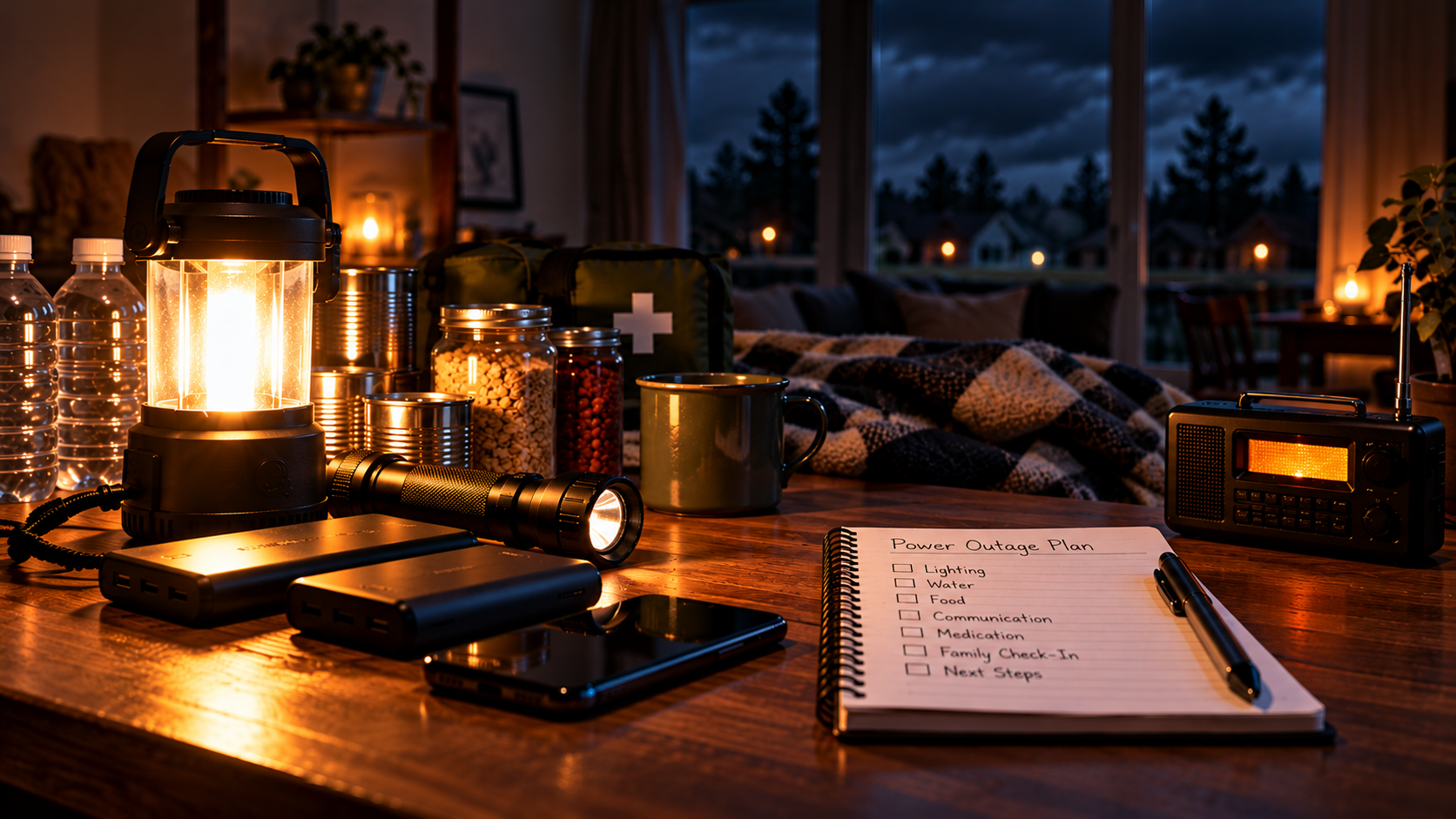
Most people don't think much about electricity until it disappears.
You flip a switch. Nothing happens.
You check another room. Still nothing.
Your Wi-Fi is down. The television is off. The refrigerator has stopped humming. Your phone still works, but you suddenly realize you have no idea how much battery you have left.
For the first few minutes, it might even feel like a minor inconvenience.
But electricity is more than a convenience. It supports many of the systems we depend on without thinking about them: communication, heating, refrigeration, water distribution, payment systems, transportation, and access to information.
When the power goes out, some of those systems may stop immediately. Others may continue operating for hours before their backup capacity runs out.
And that creates an important distinction.
A power outage is not automatically an emergency. But an ordinary inconvenience can become an emergency when essential needs can no longer be met.
The purpose of power outage preparedness is not to turn your home into a fortress or prepare for the collapse of civilization.
It is to understand your dependencies, establish reasonable alternatives, and maintain the ability to make good decisions when normal systems are unavailable.
That is what personal preparedness is about.
1. Understanding the Real Problem
When people think about preparing for a blackout, they often focus on equipment.
Generators. Batteries. Solar panels. Emergency lights. Power stations.
Some of these tools can be extremely useful.
But equipment is only part of the equation.
The more important question is:
What functions does your household need to maintain, and what happens when the systems supporting those functions fail?
Consider five essential areas:
- Safety: Can everyone move around the home safely? Are heating, cooking, and electrical systems being used correctly?
- Water and food: Can your household access safe drinking water and prepare or consume food?
- Communication: Can family members contact each other, receive information, and request assistance?
- Health and temperature: Can you maintain safe indoor conditions and support anyone with medical needs?
- Decision-making: Do you know when to wait, when to adapt, and when to seek help?
These needs remain important whether an outage lasts twenty minutes or three days.
What changes is the amount of preparation required to maintain them.
The difference between a short outage and a prolonged disruption
A short outage is usually manageable with minimal preparation.
A flashlight, a charged phone, and a little patience may be enough.
A prolonged outage is different because secondary problems begin to accumulate.
Refrigerated food becomes a concern. Batteries run down. Indoor temperatures change. Communication becomes less reliable. Everyday routines become more difficult.
The real challenge is not simply the absence of electricity.
It is the gradual loss of the services that electricity makes possible.
2. The First Ten Minutes: Assess Before You Act
Imagine the power goes out at 7:30 PM.
Your family is home. Dinner is nearly ready. Outside, the streetlights are dark.
What should you do?
The first priority is not to find every emergency item you own.
It is to establish what has happened.
Step 1: Confirm the extent of the outage
Look outside.
Are neighboring buildings affected? Are streetlights working? Does your home appear to be the only property without electricity?
If the outage appears limited to your home, check the electrical panel only if you can do so safely and understand the equipment.
Do not touch damaged wiring, flooded electrical equipment, exposed conductors, or anything showing signs of overheating.
If you notice smoke, sparks, burning smells, or other signs of electrical danger, move away and contact the appropriate emergency service or qualified professional.
If the neighborhood is affected, check whether your electricity provider has published an outage notice.
Step 2: Establish safe lighting
Use flashlights, rechargeable lanterns, or battery-powered lights.
Avoid relying on candles. Open flames create an unnecessary fire risk, particularly around children, pets, or cluttered rooms.
One centrally located lantern may be more useful than several people wandering through a dark house with their phone flashlights.
Step 3: Check your household
Account for everyone.
Does anyone need immediate assistance?
Is someone using electrically powered medical equipment? Is there an infant, older adult, or person with limited mobility who may need additional support?
These questions determine whether the outage is merely inconvenient or potentially urgent.
Step 4: Protect your remaining resources
Keep refrigerator and freezer doors closed.
Reduce unnecessary phone use.
Unplug sensitive electronic equipment where appropriate to reduce exposure to possible restoration-related surges, while leaving a suitable light switched on to indicate when electricity returns.
Step 5: Avoid making assumptions
You may hear rumors about how long the outage will last or what caused it.
Treat unverified information cautiously.
A local equipment failure, severe weather, and a wider infrastructure disruption can initially look similar from inside your living room.
Your first job is to establish the situation, not invent an explanation. (Learn how evaluating your environment prevents false assumptions in Understanding Your Baseline).
3. The Timeline: What Changes as an Outage Continues?
Time is one of the most important variables in any disruption.
The longer essential systems remain unavailable, the more important preparation becomes.
The following timeline is illustrative, not a prediction. Actual consequences depend on weather, local infrastructure, household needs, and available backup systems.
After two hours: Mostly inconvenience
For many households, a two-hour outage is manageable.
Your phone may still have plenty of battery. Refrigerated food may remain safely cold if doors stay closed. The indoor temperature may not have changed significantly.
The biggest problems are often practical:
- Interrupted cooking
- No Wi-Fi
- Limited lighting
- Electric garage doors or gates that cannot operate normally
- Heating or cooling systems that have stopped
At this stage, conserving resources and monitoring reliable information may be all that is necessary.
However, someone dependent on powered medical equipment may need to act immediately rather than wait.
After twelve hours: Dependencies become visible
Now the situation starts to change.
Phone batteries may be running low. Food storage becomes more difficult. Depending on the weather and building, indoor temperatures may become uncomfortable or unsafe.
If the outage affects a larger area, shops, fuel stations, and payment terminals may be disrupted.
Households relying entirely on electric cooking may have limited meal options.
Your priorities should shift toward preserving safe food and water, managing indoor temperature, and establishing reliable communication.
After twenty-four hours: Planning matters more than equipment
After a full day without power, routines begin to break down.
People may struggle to obtain updated information, prepare meals, maintain hygiene, or keep medical supplies at the required temperature.
A household that has planned alternative methods will usually have more options.
A household that has not may be forced to improvise under pressure.
This is also when you should reassess whether remaining at home is still the safest option.
After seventy-two hours: Resilience becomes the priority
Three days without electricity does not automatically mean society has collapsed.
But it does mean that a household may need to function independently of several familiar services for a meaningful period.
Stored drinking water, nonperishable food, alternative lighting, backup communication, essential medication, and a realistic family plan become especially valuable.
The objective is not to preserve your normal lifestyle.
It is to preserve essential functions until services return or another safe solution becomes available.
4. Hidden Dependencies: What Else Stops Working?
One of the biggest mistakes in emergency planning is treating each system as independent.
In reality, many systems rely on electricity somewhere in their operation.
Water supply
Water may continue flowing during an outage, especially where gravity-fed systems or backup power are available.
But pumps, treatment facilities, and building pressure systems may depend on electricity.
Some high-rise buildings and properties using private wells can lose water pressure relatively quickly.
A functioning tap during the first hour does not guarantee that water service will continue indefinitely.
This is why storing emergency drinking water is a sensible precaution. For a detailed approach, see our guide to Emergency Water Storage.
Heating and cooling
Even homes heated with gas or oil may require electricity for controls, circulation pumps, ignition, or fans.
Air-conditioning systems generally stop when grid electricity fails unless backup power is available.
During cold weather, the main challenge may be maintaining a safe indoor temperature.
During a heatwave, overheating can become a more immediate danger, particularly for infants, older adults, and people with certain health conditions.
Communications
Mobile phones may continue operating while network infrastructure has backup power.
But local towers can become overloaded, lose power, or experience other failures.
Your home internet router will normally stop working without electricity, even if the provider's network remains operational.
A charged phone is useful.
A charged phone with no available network is much less useful (see our guide to Emergency Communications).
Payments and fuel
Card terminals, cash machines, electronic registers, and fuel pumps may require electricity.
Even if a business is open, it may be unable to process transactions.
A modest amount of cash in suitable denominations can provide an additional option.
Access and mobility
Electric garage doors, building entry systems, elevators, traffic signals, and charging infrastructure can all be affected.
Know how to operate essential doors and access systems manually, following their manufacturer instructions.
Never use an elevator during an outage, and do not attempt to force open elevator doors if someone becomes trapped. Contact the building operator or emergency services as appropriate.
The important lesson is simple: A system does not need to be directly connected to your home to affect your safety.
5. Water, Food, and Hygiene
These are not glamorous preparedness topics.
But they are among the most practical.
Drinking water
A useful household plan should account for drinking, basic food preparation, and the needs of children, pets, and anyone requiring additional water.
For a baseline planning figure, some emergency authorities recommend approximately 2 liters of drinking water per person per day, while others recommend larger amounts to include cooking and sanitation.
Your actual requirements depend on climate, health, activity, and household circumstances.
Water stored in clean, food-safe containers is generally more dependable than assuming that you will be able to collect or filter water later.
Filtration alone does not necessarily remove every chemical contaminant or pathogen.
Follow local public-health instructions if authorities issue a boil-water or do-not-use notice.
Refrigerated and frozen food
A closed refrigerator can keep food cold for a limited time. A well-filled freezer generally maintains safe temperatures longer than a partly empty one.
However, exact safe storage periods depend on appliance temperature, room conditions, how often doors are opened, and the type of food.
Food safety authorities such as the USDA provide specific guidance for outages, including commonly cited estimates of about four hours for an unopened refrigerator and up to 48 hours for a full unopened freezer.
These are planning guidelines, not guarantees.
Use a refrigerator or freezer thermometer when possible, and follow official guidance for deciding what to discard.
Do not rely on smell or taste to determine whether potentially hazardous food is safe.
Cooking without electricity
Your safest and simplest backup may be food that requires no cooking.
Shelf-stable meals, canned foods, crackers, nuts, and other familiar products can reduce dependence on cooking equipment.
Portable camping stoves, charcoal grills, and gas-powered cooking devices must never be used indoors or in enclosed or partially enclosed spaces where dangerous combustion gases can accumulate.
Carbon monoxide is invisible, odorless, and potentially fatal.
Hygiene and sanitation
If water service continues, basic hygiene may remain relatively straightforward.
If water or wastewater systems fail, sanitation becomes more complicated.
Keep essential hygiene supplies available, including soap, hand sanitizer, toilet paper, disposable gloves where useful, and heavy-duty waste bags.
Follow local public-health guidance for toilet use and waste disposal if sewer systems are affected.
Preparedness is not just about what you can eat.
It is also about maintaining conditions in which people can remain healthy.
6. Backup Power: Start With the Function, Not the Device
A common mistake is purchasing expensive backup equipment before deciding what it needs to power.
Start with the question:
Which devices are essential, and for how long must they operate?
A phone and small LED light require relatively little electricity.
A refrigerator, electric heater, or air conditioner requires much more.
Power banks
For most households, one or more charged power banks are an inexpensive and practical starting point.
They can extend the operating time of phones and other small USB-powered devices.
Keep charging cables together with the power banks, and check them periodically.
Portable power stations
Battery-powered power stations can support selected devices during an outage.
Their usefulness depends on battery capacity, output limits, appliance consumption, and the required operating time.
For example, a device consuming 50 watts continuously would theoretically use 600 watt-hours over twelve hours, before accounting for conversion losses and other inefficiencies.
That calculation matters more than the marketing claim printed on the box.
Generators
Generators can provide significant backup power, but they introduce serious risks.
Never operate a fuel-powered generator inside a home, garage, basement, or other enclosed space.
Operate it outdoors, well away from doors, windows, vents, and occupied buildings, following the manufacturer's instructions and relevant safety guidance.
Never connect a portable generator directly to household wiring through an improvised connection or wall outlet. Unsafe backfeeding can endanger utility workers, neighbors, and occupants.
A properly installed transfer system requires qualified professional assistance.
Medical equipment
If someone depends on electrically powered medical equipment, their backup plan must be developed before an outage.
Consult the healthcare provider and equipment supplier about battery duration, backup requirements, emergency contacts, and alternative care arrangements.
Do not assume that an ordinary consumer power bank can safely operate medical equipment.
7. Different Households, Different Risks
A family with young children does not have exactly the same requirements as a person living alone.
An apartment on the tenth floor presents different challenges from a detached house with a private well.
Preparedness should reflect those differences.
Families with children
Children may experience an outage as exciting at first and frightening later.
Maintain familiar routines where possible.
Explain what is happening in simple terms, without creating unnecessary anxiety.
Keep age-appropriate lighting, familiar food, essential supplies, and activities available.
A child who knows where the flashlight is and understands the family plan is less likely to feel helpless.
Older adults
Older adults may face additional challenges involving mobility, medication, temperature regulation, or communication.
Check whether they can safely navigate their home without normal lighting.
Consider whether they can open doors manually, contact someone for assistance, and access necessary supplies.
Apartment buildings
Apartment residents may depend on shared heating, water pumps, elevators, electronic access systems, or underground parking.
Find out which services have backup power and which do not.
Understand the building's emergency procedures.
Detached houses
Homeowners may have greater control over backup equipment but also more systems to maintain.
Private wells, heating circulation pumps, sump pumps, electric gates, and security systems may all require electricity.
A basement prone to flooding can become a priority long before phone charging becomes a problem.
The right preparedness plan is the one built around your actual household, not someone else's equipment list.
8. The Family Power Outage Plan
A good emergency plan should be simple enough to use when everyone is tired, distracted, or stressed.
It does not need to be complicated.
It needs to answer a few important questions.
Who does what?
Assign basic responsibilities.
One adult may check official information and contact family members.
Another may organize lighting, food, and essential supplies.
Older children can help with age-appropriate tasks.
Responsibilities should be flexible. The plan must still work if one person is absent.
How do we communicate?
Establish a primary communication method and at least one alternative.
For example:
- Primary: Phone call or messaging service
- Secondary: SMS, which may sometimes succeed when voice networks are congested
- Backup: Predetermined contact person or meeting arrangement
Agree on an out-of-area contact who can help relay information if local networks are disrupted.
Where do we meet?
If family members are away from home when the outage occurs, they should know whether to return home, remain at a safe location, or use a predetermined meeting point.
The plan must account for the possibility that roads, public transport, and communication systems are affected.
When do we reassess?
Set decision points.
For example:
- After the first hour: What do we know?
- After several hours: Are essential needs still covered?
- Before nightfall: Is the home safe and sufficiently warm or cool?
- The next morning: Can we reasonably remain here?
These are not rigid deadlines.
They are reminders to make decisions deliberately rather than waiting indefinitely.
For more detail, see Emergency Communications and Family Emergency Planning in the FSSP Knowledge Base.
9. When Staying Home Is No Longer the Best Option
Most short power outages do not require evacuation.
In fact, unnecessary travel can create additional risks.
But staying home should not become a matter of pride.
Consider seeking another safe location when essential needs can no longer be met.
Examples include:
- Indoor temperatures becoming unsafe
- Essential medical equipment lacking adequate backup power
- Necessary medication being at risk because required storage conditions cannot be maintained
- No access to safe drinking water
- Flooding, fire, electrical hazards, or other immediate dangers
- A household member requiring assistance that cannot be provided safely at home
If there is an immediate threat to life or health, contact emergency services rather than waiting for a scheduled reassessment.
If relocation becomes necessary, choose a known safe destination where essential services are available.
Confirm that the destination can actually accommodate you if communication is possible.
Bring essential medication, identification, appropriate clothing, communication devices, and necessary supplies.
Preparedness is not about remaining in place at all costs. It is about preserving options.
10. A Practical Scenario: A Winter Evening Without Power
Imagine a family of four living in a suburban house.
It is 6:45 PM in January.
The lights go out while dinner is being prepared.
Outside, neighboring houses are dark.
The heating system stops.
The first ten minutes
The family locates two LED lanterns.
One parent checks the electricity provider's outage information.
The other makes sure everyone is accounted for and checks whether any immediate needs require attention.
They keep the refrigerator closed.
Nobody begins searching for a generator or improvising a heating solution.
Two hours later
The outage remains unresolved.
The family eats food that does not require cooking.
Phones are switched to power-saving mode.
They gather in one room to make lighting and supervision easier.
They check the indoor temperature and use suitable clothing and blankets for warmth.
Twelve hours later
The house has become noticeably colder.
The family reviews available information and checks on an older relative nearby.
They reassess the temperature, available water, and essential supplies.
They also consider whether an alternative location with reliable heating may be necessary.
The following morning
There is still no reliable restoration estimate.
The family decides whether their current conditions remain safe.
If the house is becoming too cold, they have a predetermined option to stay with relatives whose heating is working.
They do not wait until the situation becomes dangerous before considering that option.
What made the difference?
Not expensive equipment.
Not military-style survival training.
The family had lighting, basic supplies, a communication plan, and an understanding of its priorities.
Most importantly, they had established decision points.
That reduced the need to improvise.
11. The Practical 72-Hour Power Outage Checklist
The following checklist is a starting point for an ordinary household. Adapt it to your climate, family size, medical requirements, and local emergency guidance.
Lighting and energy
- Battery-powered or rechargeable flashlights
- LED lantern for shared spaces
- Spare batteries where applicable
- Charged power banks
- Charging cables for essential devices
- Safe backup power for genuinely essential equipment, if required
Water and food
- Drinking water appropriate for the household
- Shelf-stable food for several days
- Food requiring little or no preparation
- Manual can opener
- Supplies for infants, pets, or special diets
- Refrigerator/freezer thermometer
Communication and information
- Written emergency contact list
- Electricity provider's outage contact information
- Out-of-area family contact
- Predetermined family meeting arrangements
- Battery-powered or hand-crank radio where useful
- Important local emergency information sources
Health and hygiene
- First-aid supplies
- Essential medications and an appropriate refill plan
- Backup arrangements for electrically powered medical equipment
- Hygiene supplies
- Toilet paper and waste bags
- Weather-appropriate clothing and blankets
- Working smoke and carbon monoxide alarms where relevant
Household and practical needs
- Modest emergency cash reserve
- Accessible identification and important documents
- Knowledge of manual door and gate operation
- Suitable supplies for children and dependent household members
- A safe alternative destination if remaining home becomes impossible
This checklist is not a shopping competition.
You may already own most of what you need.
The important question is whether those items are accessible, functional, and sufficient.
12. Test Your Plan Before You Need It
A preparedness plan that has never been tested is partly an assumption.
Fortunately, testing does not require creating a dangerous situation.
Try a simple household exercise.
The two-hour blackout exercise
Choose a suitable evening when everyone is home.
Do not disconnect essential appliances, disable safety systems, or interfere with medical equipment.
Instead, simulate the loss of normal household electricity by voluntarily avoiding nonessential electric lighting, television, Wi-Fi, and other conveniences.
Use your backup lighting.
Locate your emergency contact list.
Identify how you would receive official information.
Discuss what you would eat if cooking were unavailable.
Ask each family member where the essential supplies are stored.
Then review the experience.
What worked?
What was difficult?
What did you assume you had but could not find?
What depended on a single device or person?
You will probably discover that a few small organizational improvements matter more than purchasing another expensive gadget.
That is exactly the point.
13. Common Power Outage Preparedness Mistakes
Mistake 1: Buying equipment without a plan
A large battery or generator may be useful, but it cannot replace an understanding of essential household needs.
Define the problem before purchasing the solution.
Mistake 2: Assuming mobile networks will always work
Phones are valuable tools, but networks may become congested or unavailable.
Create alternative communication arrangements.
Mistake 3: Using unsafe heating or cooking methods
Never use charcoal grills, camping stoves, portable fuel-powered generators, or gas ovens as improvised indoor heating solutions.
Combustion appliances can produce deadly carbon monoxide.
Mistake 4: Opening the refrigerator repeatedly
Every unnecessary opening allows cold air to escape.
Plan meals and food checks deliberately, and follow food safety guidance.
Mistake 5: Ignoring medical and accessibility needs
For some people, electricity is not merely convenient.
It may support essential treatment, mobility, or health-related equipment.
These needs must receive priority.
Mistake 6: Assuming every outage will last for days
Preparedness should be proportionate.
Not every power failure requires drastic action.
Use verified information and reassess conditions rather than assuming the worst.
Mistake 7: Failing to maintain supplies
A discharged power bank, expired medication, empty flashlight, or outdated contact list provides little value.
Schedule simple periodic checks.
Mistake 8: Waiting too long to change plans
If your home can no longer meet essential safety or health needs, seeking assistance or relocating may be the correct decision.
There is no prize for enduring unnecessary risk.
14. Frequently Asked Questions
Establish safe lighting, account for household members, determine whether the outage affects your home or a wider area, and check reliable information sources. Identify any immediate medical, electrical, or temperature-related risks before focusing on convenience.
A 72-hour preparedness plan is a practical starting point for many households, but local authorities may recommend longer periods of self-sufficiency. Your plan should reflect local hazards, climate, household vulnerabilities, and available support.
Not necessarily. Many households can cover basic needs with flashlights, power banks, stored water, shelf-stable food, and a communication plan. Generators may be appropriate for specific power requirements but involve cost, maintenance, installation considerations, and serious safety risks.
Possibly. Water availability depends on the local supply system, building infrastructure, and backup power arrangements. Private wells and buildings relying on electric pressure pumps may be particularly vulnerable. Keep a suitable emergency water supply.
Agree on backup contact arrangements before an emergency. These may include an out-of-area contact, predetermined meeting points, written information, and suitable radio-based information sources. No single communication method is guaranteed to work in every disruption.
Use suitable clothing, blankets, and safe indoor arrangements while monitoring room temperature and individual health needs. Do not use unsafe combustion devices indoors. If the home becomes dangerously cold, seek a safely heated alternative location.
Often, remaining at home is reasonable when the building is safe and essential needs can be maintained. But medical dependencies, extreme temperatures, lack of drinking water, or other hazards may make relocation necessary. Evaluate actual conditions rather than following a rigid rule.
15. Preparedness Is About Maintaining Options
A power outage reveals something important about modern life.
We depend on systems that usually work so reliably that we rarely notice them.
Electricity is one of those systems.
When it disappears, our first reaction is often to focus on what we have lost.
The lights.
The internet.
The television.
The ability to charge our phones.
But effective preparedness asks a different question:
What do I still need to accomplish, and what alternatives do I have?
You need to keep your family safe.
You need access to water, food, information, and essential medical support.
You need to maintain reasonable living conditions.
And you need to recognize when circumstances require a change of plan.
None of this demands extreme survivalism.
It demands awareness, preparation, and practical decision-making.
Start small.
Identify your dependencies.
Prepare sensible alternatives.
Test your arrangements.
Improve what does not work.
Because the goal is not to control every possible emergency.
The goal is to remain capable when normal systems stop working.
Continue Building Your Preparedness
Power outage preparedness is one part of a broader personal protection strategy.
Explore these related FSSP Knowledge Base guides:
- Emergency Water Storage — How much water your household needs and how to store it safely.
- Emergency Communications — Maintaining contact when familiar communication systems become unreliable.
- Family Emergency Planning — Building a practical plan that everyone in your household understands.
At Full Spectrum Self Protection, we focus on the knowledge, decisions, and practical skills that help ordinary people handle extraordinary situations.
Personal Preparedness. For the Real World.
Build your knowledge. Strengthen your options. Prepare with purpose.