Not all violence is the same.
That sounds obvious. Yet much of what is taught as self-defense treats violence as if every dangerous encounter follows roughly the same script:
- •Someone becomes aggressive.
- •The situation escalates.
- •A physical attack begins.
- •You defend yourself.
Real-world violence is considerably more complicated.
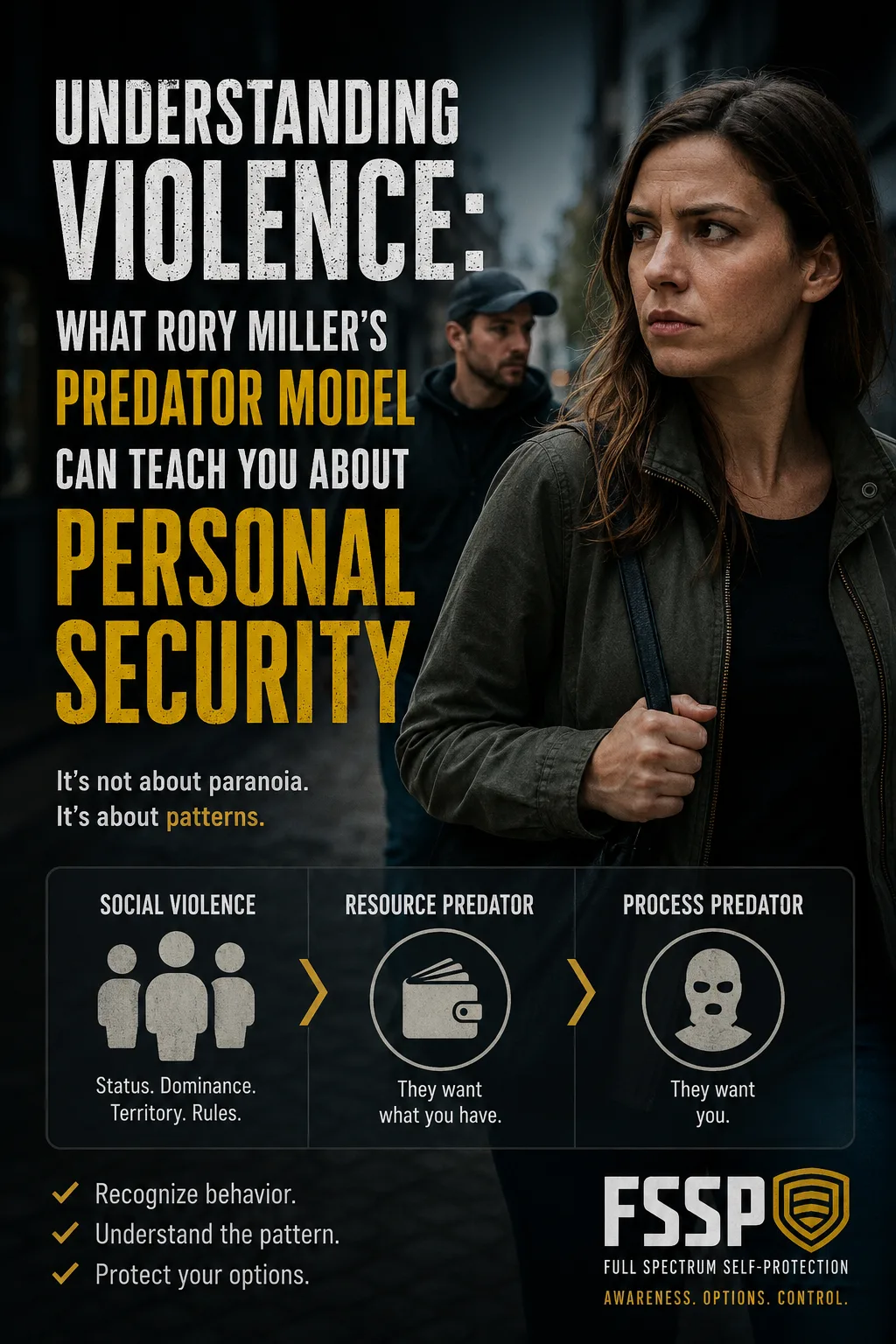
One useful framework for understanding this comes from author and former corrections officer Rory Miller, whose work on violence dynamics distinguishes broadly between social violence and asocial violence. Within predatory violence, Miller further describes two useful categories: the Resource Predator and the Process Predator.
The important point is not memorizing terminology. It is understanding a much more important question: What does this person actually want?
Because the answer can completely change what you should do next.
Social Violence vs. Asocial Violence
Miller's model begins with a fundamental distinction.
Social Violence
Social violence occurs within a social context. It can revolve around:
- •status
- •dominance
- •reputation
- •territory
- •group membership
- •enforcing perceived rules
The classic example is an argument that begins with something like: "What are you looking at?" The words are almost irrelevant. The interaction is really about status.
Miller describes several recurring patterns within social violence, including what he calls the Monkey Dance, Group Monkey Dance, Educational Beat Down, Status Seeking Show, and territorial violence.
These situations can absolutely become dangerous. People can be seriously injured or killed during conflicts that began over something trivial. But the underlying dynamic matters because social violence frequently involves communication, positioning, status, and an audience.
Miller points out an especially useful distinction:
"In many forms of social violence, other people function as an audience. In predatory violence, those same people may instead become witnesses — something the offender may prefer to avoid."
That difference matters.
Predatory Violence Is Different
Asocial or predatory violence operates according to another logic. You may no longer be treated primarily as another participant in a social conflict. You may be treated as a resource. Or as part of the offender's desired process.
This is where Miller's distinction between two broad predator types becomes particularly useful.
The Resource Predator
A Resource Predator wants something you possess. That could be:
- •money
- •your phone
- •your wallet
- •jewelry
- •your vehicle
- •access to property
Violence is not necessarily the primary objective. It is a tool used to obtain the resource.
A robber pointing a weapon at someone and demanding a wallet is a straightforward example. The offender may be perfectly willing to use violence. But if intimidation achieves the objective with less risk, intimidation may be preferable.
This distinction creates an important self-protection question: Is the property worth fighting for?
Usually, no. Phones can be replaced. Wallets can be replaced. Cars can be replaced. Your life cannot.
If surrendering an object ends the encounter, giving up that object may be the safest available option. But there is an extremely important qualification.
When Giving Them What They Want Doesn't End the Situation
Imagine someone demands your wallet. You hand it over. But they don't leave. Instead they say: "Get in the car."
The situation has fundamentally changed. The resource was apparently not the entire objective. And this brings us to Miller's second category.
The Process Predator
For what Miller calls the Process Predator, the act itself is the objective. The offender isn't simply using violence to acquire an object. The victim — and what the offender intends to do with the victim — is central to the goal.
Miller associates this category with offenses such as predatory sexual violence, torture, and certain forms of homicide.
And this creates one of the most important questions in personal security: Why does this person still need you?
If someone already has:
- •your phone
- •your wallet
- •your keys
- •your valuables
...but still wants you, something has changed. That should dramatically alter your assessment of the situation.
The Secondary Location Problem
One particularly serious warning sign is an attempt to move a victim from one location to another. For example:
- •"Get into the car."
- •"Come inside."
- •"Go into the back room."
- •"Walk over there."
Miller discusses this in terms of movement toward a secondary crime scene. A process-oriented offender may benefit from greater privacy, more control, and additional time with the victim.
From a personal-security perspective, that means the attempt to relocate you deserves enormous attention. The new location may offer the offender: more privacy + more control + fewer witnesses + more time.
Those are not advantages you want to give someone who may intend to harm you.
This does not mean every request to move proves somebody intends serious violence. Personal security should never be based on pretending we can read minds. Instead, we assess behavior, context, and patterns.
Dangerous Interactions Often Begin Normally
One of the biggest misconceptions about predators is that they immediately look dangerous. Sometimes they do. Often they don't.
An interaction might begin with a conversation. Then a request. Then a small boundary violation. Then another.
None of those behaviors alone proves criminal intent. But together they may form a pattern. And patterns matter.
This connects directly to Boundary Testing. Someone may be learning things about you through seemingly minor interactions:
- •Will you say no?
- •Will you create distance?
- •Will you challenge inappropriate behavior?
- •Will you allow them to move closer?
- •Will you follow instructions simply because they are delivered confidently?
The issue isn't paranoia. It is recognizing when an interaction repeatedly moves in one direction: toward greater control and fewer options for you.
Watch What Happens When You Set a Boundary
Sometimes the most useful information isn't the initial behavior. It's what happens after you resist it.
Imagine someone approaches you. You move back. They move closer again. You reposition. They follow. You say: "No, I'm fine." They continue insisting.
Individually, each behavior might have an innocent explanation. But the pattern is becoming increasingly relevant. Your boundary produced information.
A person with legitimate intentions will often recognize and respect reasonable boundaries. Someone attempting to manipulate, control, or position you may instead repeatedly test them.
Again: This doesn't prove criminal intent. It tells you the situation deserves more attention.
Don't Diagnose the Person — Read the Situation
There is an important limitation to all models like this. You cannot look at a stranger and reliably declare: "That's a Process Predator."
Human behavior isn't that simple. Even Miller emphasizes that violence-dynamics categories are models rather than absolute truths. They are tools for thinking about complicated interactions, not diagnostic labels.
Real incidents can overlap. Motivations can change. A robbery can become something else. A social confrontation can escalate into extreme violence. And you may never know exactly what another person intended.
Fortunately, you don't need to. Personal security doesn't require mind reading. It requires noticing meaningful changes in behavior.
Ask Better Questions
Instead of asking: "Does this person look dangerous?"
Ask:
- •What does this person want?
- •Why are they approaching me?
- •Are they respecting distance?
- •Are they respecting my refusal?
- •Are they trying to isolate me?
- •Are they trying to move me somewhere else?
- •Did their behavior change when I established a boundary?
And perhaps most importantly: Is this interaction increasing or decreasing my options?
That question cuts through a lot of noise. If someone continually tries to reduce your ability to leave, create distance, attract attention, or make independent decisions, the situation deserves immediate attention.
The Goal Is Not Paranoia
Personal security isn't about assuming everyone is dangerous. That mindset is neither realistic nor sustainable.
The objective is to recognize when ordinary behavior begins forming an unusual pattern. Most conversations are just conversations. Most requests are just requests. Most strangers are simply strangers.
But when several small anomalies begin pointing in the same direction, ignoring them simply because none individually proves danger is a mistake.
You don't need proof to:
- •create distance
- •end a conversation
- •move toward other people
- •enter a public business
- •call someone
- •change direction
- •or leave
You are not conducting a criminal investigation. You are managing your exposure to risk.
Awareness Before Physical Skills
This is one reason Full Spectrum Self-Protection places so much emphasis on situational awareness, behavior, and decision-making.
Physical skills matter. But the best outcome is usually not winning a fight. It's recognizing the developing problem early enough that the fight never happens.
Miller describes three broad strategies for avoiding assault: absence, escape and evasion, and de-escalation — with absence being the most efficient because you never enter the dangerous interaction in the first place.
That principle fits directly into the FSSP approach:
- •Awareness gives you time. (You can establish a solid foundation by Understanding Your Baseline).
- •Time gives you options. (Recognizing pre-attack indicators early changes the game).
- •Options give you control.
- •And control dramatically improves your chances of avoiding violence altogether.
The Bottom Line
These categories aren't a tool for predicting exactly what someone will do. They're a framework for understanding different violence dynamics and asking better questions.
A person demanding your property presents one problem. A person who already has your property but still wants control over you presents a very different one.
A stranger asking an innocent question may mean nothing. A stranger who repeatedly ignores boundaries, follows your movement, tries to isolate you, and attempts to reduce your options presents a pattern worth taking seriously.
Don't wait for someone to prove that they are dangerous before allowing yourself to act. You don't need certainty. You need enough information to make the next good decision.
- •Pay attention to behavior.
- •Pay attention to context.
- •Pay attention to patterns.
Because dangerous interactions don't always start with violence. Sometimes they start with a conversation.
About Rory Miller
Rory Miller is an author and former corrections officer whose work focuses on violence dynamics, conflict, and real-world self-protection. His books include Meditations on Violence and Facing Violence: Preparing for the Unexpected. His models of social and asocial violence have become influential within parts of the practical self-defense community.